

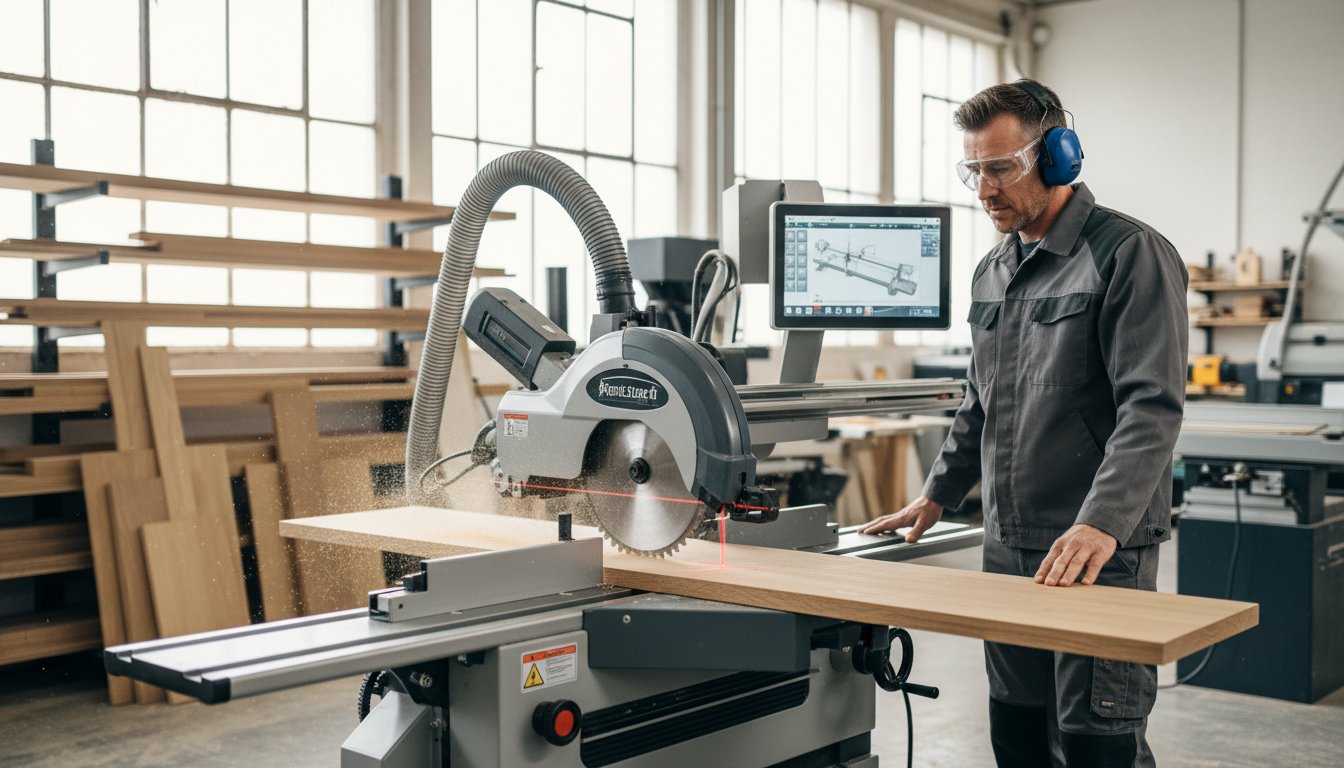
How much does a 5% margin of error in your initial timber processing actually cost your business over a 260 day production year? For many UK joinery firms, inaccurate manual measuring and outdated machinery account for over £12,000 in avoidable material wastage annually. You likely recognize that the length cutting stage is often the primary bottleneck in your workshop. It’s the point where production speed hits a wall and where HSE compliance concerns regarding older equipment can create genuine operational anxiety for workshop managers.
This guide demonstrates how upgrading to a modern, precision engineered cross cut saw can transform your throughput while ensuring your facility meets the latest safety standards. We’ll show you how to eliminate manual measurement errors and reclaim those lost margins through engineering excellence and robust workflow optimization. We examine the technical specifications of high performance machinery, the integration of automated stop systems, and the essential maintenance protocols required to ensure long term reliability with UK based technical support.
Key Takeaways
- Understand the critical engineering distinctions between consumer-grade equipment and a dedicated industrial cross cut saw to ensure your machinery meets high-volume production demands.
- Evaluate the performance benefits of manual and semi-automatic pneumatic systems to identify the optimal balance of throughput and operator effort for your specific workshop workflow.
- Learn how to leverage advanced optimisation software and precision-engineered TCT blades to maximise timber yield and significantly reduce material waste.
- Ensure your facility remains fully compliant with UK PUWER regulations by implementing mandatory safety features including braked motors, guarding, and emergency stops.
- Discover how 50 years of technical expertise and hands-on machine trials at our Newark-on-Trent showroom provide the security required for long-term capital investments.
What is an Industrial Cross Cut Saw and Why Does Your Workshop Need One?
In high-volume timber manufacturing, an industrial cross cut saw represents the foundational stage of material preparation. While a hobbyist might view cross-cutting as a simple task of dividing a board, industrial operators recognize it as a precise length-processing operation that dictates the accuracy of every subsequent stage. To understand the basics, What is a crosscut saw involves looking at how the blade severs wood fibres perpendicular to the grain, a process that requires immense stability when performed at scale. Unlike standard consumer miter saws designed for intermittent use, an industrial machine is engineered for continuous, high-speed output. It handles the heavy duty cycles of 24/7 production environments without the thermal degradation or calibration drift that plagues lighter equipment.
Workshops that transition from manual cutting to automated industrial systems often see a 25% to 35% increase in daily output. This isn’t just about blade speed; it’s about the machine’s ability to maintain squareness under the pressure of processing several hundred linear metres of timber per shift. A professional cross cut saw eliminates the “measure twice, cut once” mantra by using programmable stops and high-torque motors, ensuring the first cut is the only cut needed. This level of reliability is essential for businesses making significant capital investments in their production floor.
The Role of Cross-Cutting in the Production Line
In a professional setting, cross-cutting is a primary processing task that feeds all secondary joinery operations. If this initial stage is inaccurate, every tenon, mortise, or profile created later will be misaligned. For manufacturers utilizing Soukup window and door production lines, the cross-cut stage acts as the heartbeat of the factory. It’s often the primary bottleneck in manual shops where operators spend 40% of their time handling material rather than cutting it. Automating this process transforms the saw from a simple tool into a workflow optimiser, allowing for seamless integration with downstream CNC machinery and assembly stations. This ensures that the flow of components remains steady and predictable.
Key Engineering Differences
The distinction between industrial and consumer machinery lies in the metallurgy and electrical specifications. Industrial saws utilize heavy cast iron frames rather than pressed steel or aluminium. This mass is vital for vibration dampening, which directly affects the finish quality and blade longevity. While a DIY saw might use a 1.5kW universal motor, an industrial cross cut saw typically features a 5.5kW or 7.5kW induction motor rated for 100% duty cycles. These motors don’t overheat during 10-hour shifts. Precision tolerances are also tighter; where a consumer saw might allow for a 1mm deviation, industrial units maintain tolerances within 0.1mm. This precision is non-negotiable for high-end joinery where a £5,000 bespoke door set depends on perfectly square components. Investing in robust engineering provides the peace of mind that the machine will perform as accurately in year ten as it did on day one.
Types of Cross Cut Saws for Professional Woodworking
Selecting the right cross cut saw is a fundamental decision that dictates the flow of your entire production line. The choice usually rests on the balance between bespoke flexibility and high-volume repeatability. In the UK market, workshops typically transition through three distinct levels of technology as their output requirements grow, moving from basic manual intervention to fully autonomous CNC systems.
Manual and Semi-Automatic Solutions
For small-scale joinery firms, manual pull-over saws represent the traditional entry point. These machines allow for tactile control during bespoke commissions where every millimetre counts. While they offer versatility, they rely heavily on operator skill and physical stamina. When production volumes increase, 70% of growing workshops upgrade to semi-automatic pneumatic models to maintain consistency. These machines utilize pneumatic clamping to secure the timber with uniform pressure, which prevents material shift during the cutting stroke.
The introduction of foot-pedal operation is a significant ergonomic improvement. It frees the operator’s hands to position the timber safely while reducing the physical strain of repetitive manual pulling. This shift can reduce operator fatigue by 40% over an eight-hour shift. Safety remains the primary concern for any mechanical action. The Safety, Compliance, and PUWER Regulations established by the HSE dictate specific guarding and braking requirements for these machines to protect operators from blade contact and ensure the equipment is fit for purpose.
Choosing between a radial arm saw and an up-cut saw involves understanding the mechanical path of the blade. Radial arm saws pull the blade across the top of the timber, making them excellent for wide boards. Up-cut saws house the blade beneath the table, firing upwards only when the timber is fully clamped. This enclosed design is often preferred for its superior dust extraction and enhanced safety profile, as the blade is only exposed during the actual cut.
Automated and CNC Cross-Cutting
When production demands exceed 150 components per hour, CNC-controlled lines become essential for maintaining profitability. The Soukup Crossline 500 exemplifies this shift towards total automation. These systems use an electronic pusher to position timber with an accuracy of +/- 0.1mm, eliminating the human error associated with manual flip-stops. You can choose between push-feed and through-feed systems depending on your material handling needs. Push-feed systems are ideal for varied lengths and high precision, while through-feed systems prioritize raw speed for standardized components.
Advanced automated lines incorporate defect marking and waste removal features that significantly impact the bottom line. Operators mark knots or cracks with fluorescent chalk, and the integrated sensors tell the saw to skip those sections. This process can improve timber yield by 15% compared to manual grading. Automated waste gates then divert offcuts into a collection bin, keeping the workspace clear without manual intervention.
If you’re unsure which level of automation suits your current floor plan, our team can help you analyse your production data to find the most cost-effective machinery upgrade. Investing in a CNC-controlled cross cut saw isn’t just about speed; it’s about the precision and data integration that modern UK manufacturing requires for long-term growth.
Key Features for High-Volume Production and Yield
Engineering excellence in modern timber manufacturing isn’t just about speed; it’s about the intelligent application of force and data. An automatic cross cut saw integrates advanced hardware with intelligent software to eliminate human error and material waste. We’ve seen production facilities reduce timber offcuts by up to 18% simply by moving away from manual marking and cutting. These machines represent a significant capital investment, often starting around £15,000 for entry-level industrial models and rising based on specification and automation levels.
Blade technology is a critical factor for finish quality and machine longevity. We recommend TCT (Tungsten Carbide Tipped) blades for most industrial applications. A 500mm blade with a 72-tooth or 96-tooth configuration, running at 3,000 RPM, can process hardwoods and softwoods with equal precision. Dust extraction is non-negotiable for high-speed lines. You’ll typically need an extraction velocity of at least 25 metres per second to clear the volume of chips generated during continuous cycles. Safety and compliance are integral to these high-speed systems. While British standards govern specific requirements, international guidelines such as the Key Features for High-Volume Production and machine guarding standards provide a foundation for robust operational safety.
Material handling configurations define the footprint and workflow of your workshop. In-feed tables often range from 3 to 12 metres, while out-feed systems can include sorting gates to separate different component lengths automatically. This modularity allows for a bespoke setup that fits your specific floor plan and production volume. By automating the movement of timber, you reduce the physical strain on operators and maintain a consistent throughput that manual handling can’t match.
Software and Yield Management
Modern CNC saws use sophisticated algorithms to calculate the most efficient cutting pattern from a digital cutting list. You can import CSV or XML files directly from CAD/CAM software like SolidWorks or Cabinet Vision, reducing data entry time by 90%. Real-time reporting provides 100% visibility on material usage. This allows managers to track daily waste percentages and stock levels with absolute accuracy, ensuring every cubic metre of timber is utilised to its full potential.
Mechanical Precision Features
Precision is maintained through pneumatic top and side pressure systems that secure the timber before the blade moves. This eliminates material creep during the cut. High-accuracy encoders ensure millimetre-perfect length cutting with tolerances as tight as 0.1mm. To keep the line moving, quick-change blade systems allow operators to swap tooling in under two minutes. This significantly reduces downtime during mid-shift changes on the cross cut saw, keeping your production schedule on track without compromise.
Safety, Compliance, and PUWER Regulations in the UK
Operating an automatic cross cut saw in a UK workshop requires strict adherence to the Provision and Use of Work Equipment Regulations 1998, commonly known as PUWER. These regulations place a legal duty on employers to ensure that machinery is suitable for its intended use, maintained in a safe condition, and inspected by competent persons. The Health and Safety Executive (HSE) specifically highlights the risks associated with woodworking machinery in Woodworking Information Sheet No 36 (WIS36). This document outlines the necessity for effective guarding and braking systems. Failure to comply can result in substantial fines, which averaged £145,000 per health and safety prosecution in the manufacturing sector during 2022/23. We prioritize engineering excellence to ensure your workshop meets these rigorous standards without compromising production speed.
Compliance is not merely about avoiding litigation; it’s about protecting the long term health of your workforce and your investment. A PUWER assessment must be carried out when new machinery is installed and at regular intervals thereafter. This process identifies potential hazards, such as accidental contact with the blade or ejection of workpieces, and confirms that the current control measures are sufficient. Our approach focuses on providing robust hardware that exceeds these baseline requirements, offering peace of mind through superior Swiss and European engineering standards.
Essential Safety Hardware
Modern industrial saws must feature braked motors to minimize the risk of contact with a coasting blade. Under current HSE standards, all circular saw blades must come to a complete standstill within 10 seconds of the stop command. While many older machines still operate in UK workshops, the 2026 focus on heightened machinery safety means that any equipment failing to meet this threshold requires immediate remedial action or replacement. Interlocked guarding systems ensure that the machine cannot cycle if the protective hoods are raised, providing a physical fail-safe for the operator. For high-volume production lines where physical guards might hinder throughput, laser safety curtains provide a non-contact barrier that halts the cross cut saw instantly if the light beam is broken. Emergency stop buttons must be mushroom-headed, latching, and positioned within easy reach of the operator’s normal working position.
Maintenance for Longevity and Safety
Safety is a continuous obligation rather than a one-time setup. A robust maintenance schedule ensures that safety-critical components do not degrade over time. We recommend a structured approach to inspections:
- Daily: Test all emergency stop buttons and check that the blade guard moves freely and covers the teeth.
- Weekly: Inspect the blade for cracks or missing tips and verify the effectiveness of the braking system.
- Monthly: Audit the dust extraction flow rates to ensure compliance with COSHH regulations regarding wood dust exposure.
Professional oversight is vital for statutory compliance. Utilizing IWM technical service for annual safety audits ensures that your machinery meets the latest PUWER standards. This service provides a documented trail of compliance, which is essential for insurance purposes and HSE inspections. Sourcing genuine replacement spare parts for components like brake modules and limit switches prevents the catastrophic failures often associated with lower-quality aftermarket alternatives. It’s a methodical approach that guarantees both operator safety and machine durability.
Ensure your workshop stays compliant and productive with our expert support. Explore our PUWER-compliant industrial machinery solutions today.
Choosing IWM for Your Industrial Woodworking Machinery
Selecting industrial hardware is a significant capital commitment that impacts your bottom line for decades. At IWM, we bring over 50 years of specialized expertise to the UK woodworking industry, helping businesses move beyond simple transactions to find genuine production solutions. Our flagship showroom in Newark-on-Trent serves as a technical hub where you can bring your own timber and test a cross cut saw under real-world conditions. It’s a vital step that ensures the machinery meets your specific tolerances and speed requirements before it ever reaches your factory floor. You wouldn’t buy a fleet of vehicles without a test drive; we believe your primary processing machinery deserves the same level of scrutiny.
Our team consists of industry veterans who understand the nuances of British manufacturing. We don’t just sell equipment; we provide the technical architecture for your success. Whether you’re a high-volume pallet manufacturer, a trade supplier like Shutters Factory, or a bespoke furniture maker, our advice is grounded in practical engineering reality. We focus on long-term value and durability, ensuring that the machine you buy today is still performing at peak efficiency a decade from now. This “trusted partner” approach is why 85% of our clients return to us when it’s time to expand their production capabilities.
The IWM Advantage: From Consultation to Installation
Our engagement starts with a forensic look at your workshop’s current output. We don’t just recommend a machine. We analyze how timber moves through your facility to ensure your new cross cut saw doesn’t create a bottleneck elsewhere. This consultation often leads to bespoke workshop layouts that improve floor space utilization by up to 15%. Beyond the sale, our UK-wide engineering team manages the entire installation process. We provide hands-on operator training to ensure your staff can utilize the full programmable potential of the equipment from day one. To make these upgrades accessible, we offer tailored finance packages for both new and refurbished units, with options like Hire Purchase or leasing to suit your specific tax planning.
Total Solutions for Joinery and Timber
We believe in a “total solution” philosophy that addresses the entire lifecycle of timber processing. This includes integrating waste management systems like briquette presses directly with your sawing stations. By converting offcuts into high-density briquettes, you can reduce skip costs and generate carbon-neutral heat for your premises. For high-end joinery, we specialize in the complex integration of saws into Soukup window production lines, creating a synchronized manufacturing environment that reduces manual handling. Our engineering excellence is backed by a massive UK inventory of spare parts, ensuring that “peace of mind” isn’t just a phrase but a guarantee of minimal downtime. We’re committed to being the dependable partner that keeps your production lines moving with Swiss-level precision and local British reliability.
While using wood offcuts for heat is a smart way to manage waste, optimizing the primary heating system is another key area for cost savings. For workshops looking into modern, energy-efficient upgrades, the solutions offered by Warmteshop are worth considering, as they specialize in systems like infrared heating designed for large industrial spaces.
By choosing IWM, you’re investing in a legacy of engineering integrity. We bridge the gap between world-class manufacturing standards and personalized, local service. Our engineers are stationed across the country, ready to provide rapid response maintenance that protects your investment. It’s a comprehensive support structure designed for professionals who value craftsmanship and technical competence above all else.
Future-Proofing Your Workshop with Precision Engineering
Investing in a high-performance cross cut saw is a strategic move that defines your workshop’s output and safety profile for the next decade. We’ve detailed how the right machinery enhances timber yield and ensures your facility remains fully compliant with UK PUWER regulations. International Woodworking Machinery Ltd brings over 50 years of industry expertise to every partnership, acting as more than just an equipment supplier. As the official UK partner for prestige brands like Soukup and Falach, we deliver precision-engineered solutions that prioritize long-term value over quick transactions. Our service doesn’t end at the sale; we provide peace of mind through a comprehensive UK-wide engineering team and an extensive spare parts inventory. This technical stability is essential for B2B buyers making significant capital investments in today’s competitive market. You’ll find our approach is grounded in engineering excellence and practical results. We’re ready to help you transition to a more efficient, high-volume production model that stands the test of time.
Book a demonstration at our Newark-on-Trent showroom
We’re here to ensure your workshop operates with unrivalled efficiency and reliability.
Frequently Asked Questions
What is the difference between a cross-cut saw and a rip saw?
A cross cut saw is designed to cut across the wood grain at a 90 degree angle to the length, while a rip saw cuts parallel to the grain. Cross-cut blades feature a higher tooth count, typically 60 to 100 teeth on a 300mm blade, to ensure a clean finish without splintering the wood fibres. Rip saws use fewer, larger teeth with deep gullets to clear waste quickly during long longitudinal cuts. Using the correct machine ensures 100% accuracy in your primary dimensioning tasks.
Do I need a CNC cross-cut saw for a small joinery shop?
You don’t necessarily need a CNC model if your daily output is below 150 components, but it offers a rapid ROI for growing businesses. Small joinery firms often see a 30% increase in productivity by eliminating manual measuring and marking. We offer compact, precision-engineered models starting from approximately £12,000 that fit into smaller footprints while providing the accuracy of automated stop systems. This technology removes operator error and significantly reduces expensive timber waste.
What are the PUWER requirements for cross-cut saws in 2026?
PUWER regulations in 2026 require all industrial saws to have a braking time of under 10 seconds and enhanced interlocking guard systems. Machines must undergo a formal inspection every 12 months by a competent person to ensure continued safety compliance. Our latest range meets these 2026 standards today, featuring integrated light curtains and emergency stop circuits that exceed current HSE guidelines. Investing in modern machinery ensures your workshop remains compliant with the latest UK safety legislation.
How much space is required for an industrial automated cross-cut line?
An industrial automated cross cut saw line typically requires a linear footprint of 10 to 15 metres depending on your specific infeed and outfeed requirements. You should allow at least 1.5 metres of clearance around the machine for operator movement and routine maintenance access. For a standard 6.0m timber starting length, a total floor area of 45 square metres is the recommended minimum to maintain a safe and efficient workflow.
Can I process reclaimed timber through an automated CNC saw?
You can process reclaimed timber through an automated CNC saw provided the material is free from metal contaminants like nails or bolts. We recommend using a dedicated metal detector before processing, as a single strike can damage a £150 blade instantly. Automated systems rely on consistent sensors, so heavily distorted or uneven reclaimed boards may require pre-planing to ensure 100% accuracy during the high-speed feeding process. Our robust feeding systems are designed to handle various timber conditions with ease.
How often should the blades be sharpened or replaced on an industrial saw?
Blades on an industrial saw should be sharpened every 40 to 80 hours of actual running time to maintain cut quality and motor efficiency. If you notice a 15% increase in power consumption or visible scorching on the timber ends, it’s time for a change. Keeping a rotation of three precision-engineered blades ensures your production never stops during the 3 day professional sharpening cycle. This proactive maintenance approach protects the machine’s spindle bearings and ensures a superior finish.
What kind of dust extraction is needed for a high-volume cross-cut saw?
A high-volume saw requires an extraction system with a minimum airflow velocity of 20 metres per second at the machine connection point. For most industrial models, this equates to a volume of 1,500 to 2,500 cubic metres per hour. Proper extraction prevents 95% of fine dust buildup, which protects the sensitive internal CNC sensors and extends the lifespan of the mechanical components. Our total solutions include advice on integrating your saw with existing extraction networks.
Does IWM provide training for CNC saw software?
We provide comprehensive on-site training for all CNC saw software as part of our standard installation package. Our technicians spend 1 to 2 days with your operators to ensure they’re proficient in program creation, remote diagnostics, and routine maintenance. This support continues through our UK-wide service network, giving you peace of mind that your investment will deliver long-term value from the first day of operation. We bridge the gap between high-end engineering and practical workshop application.