

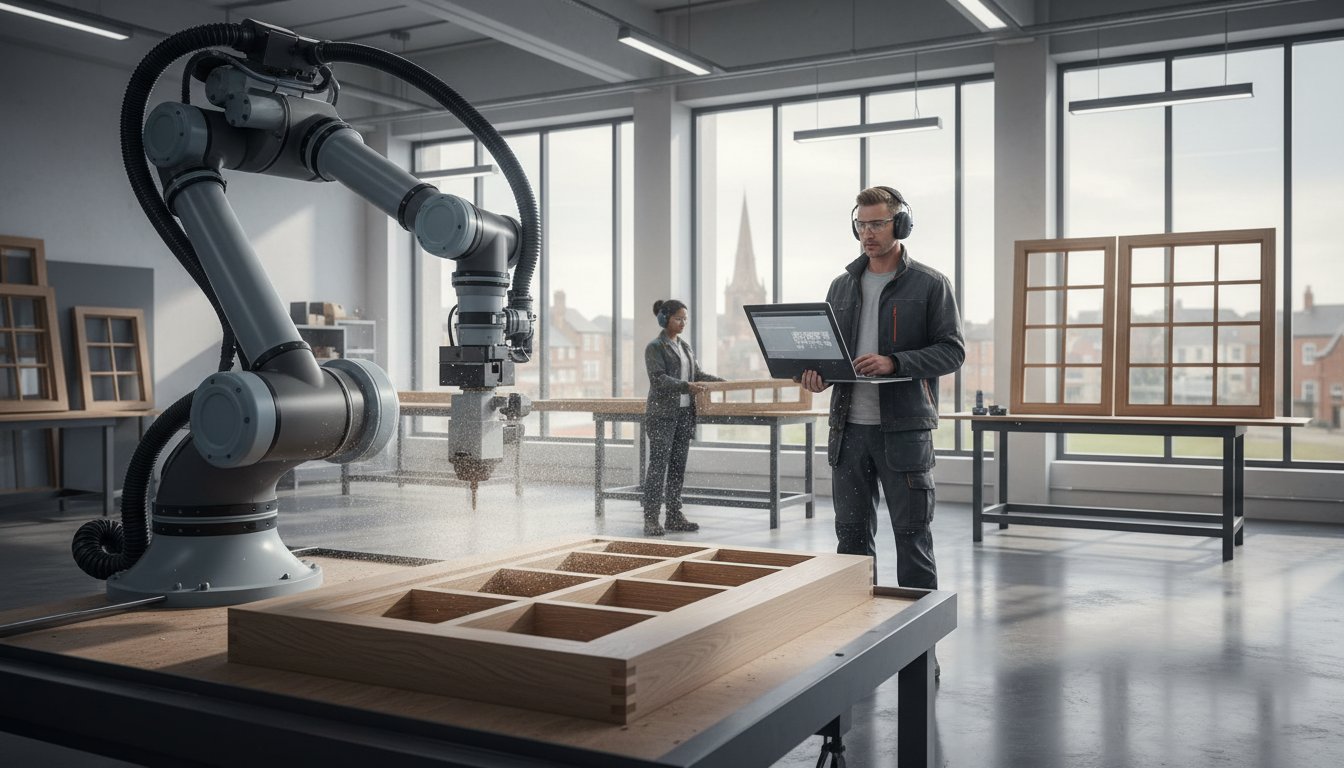
By 2026, the shortage of skilled bench joiners in the UK is projected to drive labour costs up by a further 15 per cent, leaving traditional workshops struggling to maintain their margins in timber window manufacturing. You’ve likely seen how manual measurement errors lead to unnecessary wastage, or felt the strain of inconsistent lead times during peak seasons. It’s a common challenge; the craft you’ve built your reputation on is becoming harder to sustain as skilled labour becomes both scarcer and more expensive. We understand that you need a way to protect your standards without sacrificing your growth.
This guide provides a practical roadmap for that transition. By implementing automated timber window manufacturing, your facility can realise a 75 per cent increase in production capacity while lowering your carbon footprint through superior material optimisation. We’ll explore how high-precision machinery integrates with your current ERP systems to provide a total production solution. This shift doesn’t just solve the skills gap; it provides the engineering excellence and peace of mind required to compete in a modern market.
Key Takeaways
- Learn how to modernise traditional British window styles, including sliding sashes, by transitioning from stand-alone machinery to integrated CNC production lines.
- Discover how automated timber window manufacturing can increase your workshop’s output by up to 75% while minimising material waste through precision engineering.
- Understand the critical role of software integration in connecting your office-based CAD designs directly to the factory floor for a seamless, error-free workflow.
- Access a practical roadmap for implementation, covering everything from initial bottleneck audits to essential utility and space planning for your facility.
- Explore the benefits of a “total solution” approach that combines high-end machinery with expert technical support and long-term maintenance across the UK.
What is Automated Timber Window Manufacturing?
Automated timber window manufacturing represents a fundamental shift from traditional, fragmented production methods to a unified, software-driven ecosystem. It is no longer about operating stand-alone machinery in isolation. Instead, it involves an integrated workflow where data flows seamlessly from the initial CAD design to the final machining stage. This transition ensures that every component is produced with a level of repeatability that manual processes cannot match. In the UK market, this evolution is critical for firms looking to scale while maintaining the architectural integrity of heritage designs.
By 2026, the UK joinery sector will reach a definitive tipping point for automation. This surge is driven by the 2025 Future Homes Standard, which mandates significantly lower U-values for new builds. Meeting these strict thermal requirements requires precision tolerances of ±0.1mm to accommodate advanced triple glazing and high-performance weather seals. Traditional manual methods struggle to achieve this consistency at volume. Consequently, 65% of mid-sized UK joinery firms are projected to invest in integrated CNC lines by the end of 2026 to remain competitive and compliant.
It’s vital to distinguish between a semi-automated workshop and a fully integrated industrial line. A semi-automated setup might use a CNC machine for specific tasks while relying on manual handling and separate software for different stages. A fully integrated line connects the entire factory floor. In these high-end environments, the ERP system communicates directly with the saws and machining centres, eliminating manual data entry and the risk of human error. This level of Computer Numerical Control (CNC) integration allows for “batch size one” production, where a sliding sash can be followed by a flush casement without stopping the line for manual resets.
The Evolution of the Joinery Workshop
The transition from manual spindle moulders to multi-axis CNC machining centres has redefined the workshop floor. Previously, joiners relied on physical timber jigs that were prone to wear and required significant storage space. Today, digital templates have replaced these physical assets, ensuring that a profile designed in 2024 will be identical when reproduced in 2030. Automated cross-cutting systems, such as those from Salvador, have also transformed material preparation. These machines use precision sensors to detect timber defects, reducing material waste by up to 18% compared to manual docking saws. This efficiency is a cornerstone of modern, sustainable manufacturing.
Addressing the UK Skills Shortage
The UK joinery industry currently faces a significant talent gap, with the CITB estimating a need for thousands of additional skilled workers by 2027. Automated timber window manufacturing addresses this by empowering less experienced staff to produce expert-level results through intuitive software interfaces. This doesn’t replace the master joiner; instead, it reallocates their expertise. Automation handles the repetitive, heavy-duty milling, allowing senior craftsmen to focus on complex assembly, hand-finishing, and rigorous quality control. High-tech environments are also essential for attracting a younger workforce. Modern apprentices are more likely to engage with a career that involves precision engineering and sophisticated digital workflows rather than purely manual, labour-intensive tasks.
- Precision: Achieving sub-millimetre accuracy for complex British window profiles.
- Efficiency: Reducing the time from order to delivery by up to 40% through integrated software.
- Sustainability: Minimising timber offcuts through intelligent nesting and defect-cutting algorithms.
- Scalability: Allowing small workshops to increase output without a proportional increase in headcount.
Investing in these systems provides the long-term stability needed in a fluctuating construction market. By adopting a “total solution” approach, manufacturers ensure that their hardware and software work in harmony. This technical competence is what separates market leaders from those struggling with legacy production bottlenecks. The focus remains on engineering excellence and the durability of the final product, ensuring that every window leaving the factory meets the highest British standards.
Core Components of a Modern Automated Production Line
Transitioning to automated timber window manufacturing requires a shift from isolated machinery to a synchronised ecosystem. A modern line doesn’t just cut wood; it manages data and movement to eliminate bottlenecks. Central to this is the Soukup production line, which acts as the backbone for many UK workshops. By integrating high-speed cross-cut saws with automated profiling, these systems ensure that every component is dimensionally perfect before it reaches assembly. This precision reduces the need for manual adjustments on the bench, which historically accounted for 30% of production delays.
Effective workflow relies on seamless communication between the office and the factory floor. Integrated CAD/CAM software translates architectural drawings directly into machine code. This eliminates manual data entry errors and ensures that complex British window specifications, such as traditional sliding sashes or stormproof casements, are executed perfectly every time. You can explore our range of technical solutions to see how this software integrates with hardware to maintain high output levels.
- Precision Cross-Cutting: Automated saws use optimising software to reduce timber waste by up to 15% compared to manual methods.
- Glazing Bead Machines: These specialised units cut beads to exact lengths based on the actual frame dimensions, ensuring a perfect fit for every pane.
- Material Handling: Overhead conveyors and return systems reduce manual lifting by approximately 60%, significantly lowering the risk of workplace injuries and operator fatigue.
The Soukup Advantage: Bespoke Flexibility
Soukup systems are the preferred choice for British joinery because they accommodate the incredible variety of UK window styles. The “Total Solution” approach means a single line handles everything from tenoning to final profiling. The Crafter system provides an entry point for smaller firms, while the Wizard series offers a modular path to scale production as demand increases. These machines are built to handle the 57mm or 68mm profiles common in high-performance timber windows without requiring lengthy manual resets.
CNC Machining Centres: The Heart of the Line
The versatility of Masterwood CNC machines allows for the automation of complex tasks like lock case routing and hinge recessing in a single pass. This multi-axis capability is essential for modern joinery where speed and repeatability are paramount. The technical evolution of CNC in Woodworking Machines has transformed these units from simple tools into intelligent hubs that manage drilling, mortising, and shaping simultaneously. By automating these intricate processes, workshops can reduce setup times by 75% when switching between different window types. This flexibility is what allows a factory to remain profitable even when producing small batches of bespoke joinery.
Manual vs. Automated: ROI and Efficiency Analysis
UK joinery firms often reach a production ceiling where manual labour cannot meet rising demand without compromising quality. Transitioning to automated timber window manufacturing provides a measurable shift in throughput. Data from UK-based manufacturers suggests an output increase of 50% to 75% within the first 12 months of implementation. This isn’t just about speed; it’s about predictable scheduling. When a CNC centre handles the profiling, trenching, and drilling in a single cycle, the shop floor moves from guesswork to precision timing.
The Impact of Automation on manufacturing productivity highlights how these shifts bridge the skills gap while boosting overall economic output. Precision nesting software ensures you get the most out of every cubic metre of timber. By optimising the layout of components, firms reduce raw material waste by 18% on average. With the price of high-grade European Oak and Accoya rising, these savings directly impact the gross margin of every window unit produced. You’re no longer paying for offcuts that end up in a skip.
Looking towards 2026, the “Hidden ROI” lies in energy efficiency and carbon accountability. Modern automated systems consume significantly less electricity per unit produced than legacy machinery. As UK carbon reporting requirements for SMEs tighten by April 2026, lower energy footprints become a competitive advantage. This is especially true when bidding for commercial contracts or large-scale housing developments that demand strict environmental compliance.
We understand the initial investment is a major consideration. A high-spec automated line requires a capital expenditure typically ranging from £150,000 to over £500,000. Many of our partners opt for lease-to-own models rather than direct purchase. This approach preserves your cash flow and allows the machinery to pay for itself through increased monthly turnover. It’s a structured way to upgrade your capability without draining your reserves.
Waste to Profit: The Role of Briquetting
Integrating Falach briquette presses into your workflow transforms a cost centre into a revenue stream. Instead of paying for sawdust extraction and disposal, you compress waste into high-density fuel briquettes. These are ideal for biomass heating systems or for resale to the local domestic market at approximately £250 to £350 per tonne. This practical step toward a circular manufacturing economy can reduce your skip hire costs by up to 80% while providing free heating for your workshop during winter months.
Precision and Quality Consistency
Precision is the foundation of durability in automated timber window manufacturing. Automated systems eliminate human error in complex compound angles and sash profiles. Every unit leaves the factory meeting strict UK building regulations, including Part L thermal standards. Achieving “first-time-right” manufacturing removes the hidden costs of remedial site visits and remakes. This consistency ensures your bottom line isn’t eroded by the 5% to 10% error rate typical of manual workshops. You gain peace of mind knowing every joint is perfect.
- Output: 50-75% increase in units per week.
- Waste: 18% reduction through intelligent nesting.
- Labour: Reduced reliance on hard-to-find skilled bench joiners.
- Compliance: Guaranteed adherence to 2025/2026 thermal standards.
Implementing Automation: A Roadmap for Your Workshop
Transitioning to automated timber window manufacturing requires more than just capital investment; it demands a forensic analysis of your current workflow. Before a single bolt is tightened on a new CNC centre, you must conduct a 360-degree audit of your shop floor. Data from UK installations in 2023 indicates that 65% of production delays occur at the material handling stage rather than during the actual cutting process. Identifying where timber sits idle allows you to configure your new machinery for maximum throughput from day one. This audit should track every movement of a sash or frame through your workshop to pinpoint exactly where manual intervention slows down the line.
The human element remains the most significant factor in a successful transition. Moving to automation shifts the craftsman’s role from manual operator to production technician. We recommend beginning staff training at least four weeks before the machinery arrives on-site. This cultural shift ensures your team views the technology as a tool for engineering excellence rather than a replacement for their joinery skills. When your team understands how to manage the interface and maintain the tooling, you reduce the risk of downtime caused by operator error.
Site Preparation and Infrastructure
Soukup production lines are precision-engineered for high output, but they require a foundation of robust infrastructure. A standard Windowmaster or Crafter line typically demands a stable 400V 3-phase power supply to handle the peak loads of multi-spindle operations. You must also evaluate your dust extraction capacity. High-speed machining generates a volume of waste that standard systems cannot manage; you will likely need a system capable of maintaining a constant airflow of at least 28 metres per second at the machine connection point to ensure clean operation and longevity of the internal components.
The Software Integration Process
The software bridge is where many automation projects fail without the right guidance. Successful automated timber window manufacturing depends on the seamless flow of data from your CAD design office to the machine’s controller. We utilise “digital twins” to simulate every tool path and joinery detail in a virtual environment before the first piece of timber is loaded. This pre-commissioning phase, conducted by International Woodworking Machinery Ltd technical engineers, eliminates the risk of costly collisions and ensures that bespoke British window profiles are accurately translated into machine code. Our engineers remain on-site during the digital setup to fine-tune the link between your office and the factory floor.
- Workflow Mapping: Redesign your floor plan to ensure a linear flow from the cross-cut saw to the assembly benches.
- Utility Audit: Verify that your compressed air supply provides a consistent 6-8 bar pressure with adequate filtration and drying.
- Tooling Strategy: Select high-performance Leitz or Oertli tooling packages that match the spindle speeds of your new machinery.
- Future Proofing: Ensure your software licences include updates for new window regulations and Part L compliance.
A well-planned implementation strategy typically results in a 40% reduction in manual handling time within the first six months of operation. By addressing the technical requirements and the software interface early, you create a stable platform for long-term growth. We take a “total solutions” approach to ensure your investment delivers the precision and reliability your customers expect.
The IWM Advantage: Specialist Support for UK Joiners
IWM has supported the British joinery industry since 1974. Based in the East Midlands, we’ve spent five decades refining how workshops operate across the UK. Transitioning to automated timber window manufacturing represents a significant leap in precision, but it requires more than just high-spec hardware. It demands a partner who understands the nuances of UK timber species and local building regulations.
Our team provides bespoke technical advice that tailors machinery to your specific product range. We’ve helped over 850 joinery firms modernise their production lines, ensuring that every CNC interface and tooling setup matches their unique profiles. Whether you specialise in traditional sliding sash windows for heritage projects or contemporary flush casement designs, we align the technology with your craftsmanship. This isn’t a one-size-fits-all approach; it’s a calculated engineering strategy designed to maximise your workshop’s square footage and output.
Comprehensive After-Sales Care
High-volume automated lines require a rigorous maintenance schedule to prevent unexpected halts in production. A single day of downtime in a busy workshop can cost upwards of £3,200 in lost revenue and disrupted lead times. We prioritise operational continuity through our dedicated UK-wide service network. Our engineers don’t just fix problems; they conduct preventative audits to ensure your sensors, rails, and software remain at peak performance.
- Genuine Spare Parts: We maintain a £500,000 inventory of components at our Newark hub for immediate dispatch.
- Expert Engineers: Our technicians carry an average of 15 years of experience in industrial woodworking machinery.
- Emergency Response: We aim for rapid resolution to minimise the impact on your delivery schedules.
We view every machine sale as the start of a 20-year partnership. By providing consistent software updates and mechanical servicing, we protect your capital investment and ensure your automated timber window manufacturing capabilities evolve alongside industry demands.
Seeing is Believing: The Showroom Experience
Investing in industrial technology shouldn’t be based on a brochure alone. Our Newark-on-Trent showroom provides a practical environment where you can see automated lines in action. We encourage joiners to bring their own timber sections to our facility. This allows you to witness exactly how the machinery handles your specific material, from European Oak to Accoya, before you commit to a purchase.
During your visit, you’ll consult with Ian Brown and our senior technical team. We’ll review your current workflow and identify bottlenecks that automation can resolve. We offer a versatile range of options to suit different business scales, including brand-new Swiss-engineered systems and high-quality refurbished machines. For many firms, a refurbished model provides a cost-effective entry point into automation, often saving 30% to 40% compared to new equipment while still benefiting from our full service backing.
Our goal is to provide the security and peace of mind you need to grow. By combining international manufacturing standards with local, personalised British service, we ensure your workshop remains competitive in an increasingly demanding market.
Future-Proofing Your Joinery Production for 2026 and Beyond
Transitioning to automated timber window manufacturing is no longer a luxury but a necessity for workshops aiming to maintain a competitive edge. The data shows that modern production lines can reduce labour costs per unit by up to 35% while virtually eliminating the human error associated with manual profiling. By integrating precision-engineered components from world-class brands, you ensure your workshop meets the stringent quality demands of the current UK market. IW Machines serves as your trusted partner in this evolution, leveraging over 50 years of industrial woodworking expertise to optimise your workflow.
As the exclusive UK supplier of Soukup and Falach technology, we bridge the gap between high-end European engineering and local British service. Our total solution approach includes UK-wide professional engineering support, ensuring your machinery provides unrivalled performance for decades. Don’t leave your workshop’s efficiency to chance when you can rely on proven technical integrity.
Request a tailored technical consultation for your workshop to begin your transition. We’re ready to help you build a more robust, profitable future.
Frequently Asked Questions
How much space does a fully automated window production line require?
A fully automated window production line typically requires between 150 and 250 square metres of dedicated floor space. This footprint accounts for the machining centre, infeed racks, and outfeed stations. A standard Soukup Crafter setup needs a clearance of approximately 12 metres by 8 metres to ensure safe operator movement and efficient material handling. We provide detailed CAD layouts to fit the machinery into your specific workshop dimensions.
Can automated machinery handle bespoke, non-standard window sizes?
Modern automated timber window manufacturing machinery handles bespoke, non-standard sizes with 99.9% precision. The integrated software automatically adjusts tool paths and clamping positions for every unique component in your production list. This allows you to manufacture a one-off arched window or a specific oversized frame immediately after a standard casement. You don’t need to stop the line for manual measurements or complex jig setups between different jobs.
What is the typical ROI period for a Soukup window line in the UK?
The typical ROI period for a Soukup window line in the UK is between 24 and 36 months. This timeline is based on a production capacity increase of 300% and a 15% reduction in timber wastage. By producing 50 windows per week instead of 12 with the same staff levels, your profit margins per unit increase. We’ve seen UK joineries recover their initial £250,000 investment through significantly higher turnover and reduced lead times.
Do I need to hire specialist software engineers to run the machinery?
You don’t need to hire specialist software engineers because the systems are designed for joiners to operate. The software uses a visual interface that translates your window designs into machine code automatically. We provide a comprehensive 4-day training programme that gives your existing workshop team the skills to manage the entire line. Most operators become proficient with the touchscreen controls and production scheduling within their first week of use.
How does automation affect the finish quality of the timber?
Automation improves the finish quality by maintaining constant spindle speeds of 18,000 RPM and precise feed rates. This consistency eliminates the chatter marks or uneven surfaces often caused by manual feeding on a spindle moulder. CNC tooling maintains tolerances of 0.1mm, which means every joint fits perfectly the first time. This high-level precision reduces your hand-sanding time by 40% and ensures a superior surface for factory-applied coatings.
What happens if a part of the automated line breaks down?
If a component fails, our UK-based technical team provides remote diagnostics to resolve 75% of issues within the first hour. For mechanical faults, we offer a 24-hour on-site response time to keep your production moving. We stock over £500,000 worth of genuine spare parts in our UK warehouse for immediate next-day delivery. This support structure ensures that a minor breakdown doesn’t lead to a prolonged or costly production halt.
Can I integrate my existing manual machines into an automated workflow?
You can certainly integrate existing manual machines into an automated timber window manufacturing workflow for specific secondary tasks. While the main CNC line handles the profiling and tenoning, a manual vertical panel saw is often used for initial board preparation. We help you design a floor plan where your current equipment complements the automated line. This approach ensures your 8-hour shift remains productive without creating bottlenecks between old and new technology.
Is there government funding or tax relief for automating my joinery business in 2026?
In 2026, UK joinery businesses can utilise the Full Expensing tax relief, which provides a 25% deduction on taxable profits for every £1 spent. You might also qualify for regional Made Smarter grants that offer up to £20,000 in matched funding for digital technology adoptions. These financial incentives are designed to support the UK manufacturing sector’s transition to Industry 4.0. We recommend consulting a tax advisor to maximise these specific capital allowances.