

In a 2024 audit of UK woodworking facilities, researchers found that inefficient material yield due to outdated equipment costs the average mid-sized workshop over £12,000 annually in avoidable waste. You’ve likely seen how inconsistent cutting accuracy doesn’t just waste timber; it creates a ripple effect of delays that slows down your assembly line and forces your best joiners to spend hours on manual corrections. Integrating a precision-engineered sawing machine is no longer just about making cuts. It’s about securing the technical integrity of your entire production process through superior engineering.
This guide provides a professional roadmap to selecting the right machinery to transform your workshop efficiency for 2026 and beyond. We’ll show you how to integrate high-end equipment to achieve sub-millimetre accuracy while reducing your reliance on hard-to-find skilled manual operators. We’ll explore the latest in vertical panel saw technology, workflow optimization techniques, and how a total solution approach ensures your investment delivers unrivalled long-term value and peace of mind through comprehensive UK-wide support.
Key Takeaways
- Distinguish between consumer-grade tools and professional breakout stations to establish a foundation for high-efficiency workflow optimization.
- Compare the space-saving precision of vertical panel saws with the versatility of industrial bandsaws to determine the best fit for your material types.
- Calculate the true ROI of your investment by identifying the hidden costs of material waste and operator error inherent in manual sawing.
- Learn how to specify the correct sawing machine based on your required linear meters per shift and long-term production goals.
- Discover the “total solution” approach that combines world-class engineering with the peace of mind provided by comprehensive UK-wide service.
What is an Industrial Sawing Machine? Defining Professional Standards
Industrial sawing involves more than just cutting timber to size; it’s the critical first stage where production efficiency is either won or lost. Unlike consumer-grade power tools found in home workshops, a professional sawing machine is engineered to withstand the rigours of a high-volume window production line. These machines feature heavy-duty cast iron beds and precision-ground steel tables that provide the necessary mass to absorb kinetic energy. This structural rigidity is vital. By 2026, the industry standard for mechanical tolerances in window joinery has tightened to +/- 0.1mm, a level of precision that lightweight aluminium frames simply cannot maintain under constant load.
The reliability of your workshop depends on the duty cycle of your equipment. Industrial units are designed for 100% duty cycles, meaning they run for eight to sixteen hours daily without thermal cutout or loss of alignment. This differs significantly from hobbyist tools that require frequent cooling periods. Statistics show that UK workshops upgrading to stationary industrial frames reduce material waste by 12% through improved first-time accuracy alone. It’s about ensuring that the first cut of the morning is identical to the last cut of the afternoon.
The Anatomy of Industrial Sawing Performance
High-performance output requires robust power delivery. Standard UK industrial setups utilise 415V 3-phase power to drive motors ranging from 5.5kW to 7.5kW. These motors maintain constant blade speed even when processing dense hardwoods or thick laminates, preventing the bogging down that ruins surface finishes. Blade stabilization is equally important. Advanced industrial bandsaw designs and circular saw housings now incorporate ceramic guides and vibration-dampening collars to eliminate blade flutter during heavy cuts.
Dust extraction is another non-negotiable factor for professional standards. To comply with current HSE COSHH regulations in the UK, an industrial sawing machine must be paired with extraction systems capable of maintaining air speeds of 20 metres per second at the capture hood. Efficient extraction doesn’t just protect health; it prevents dust buildup on the machine’s reference surfaces, ensuring that every workpiece sits perfectly flush against the fence.
Breakout vs. Finishing Saws
In a modern window production facility, saws are categorised by their position in the workflow. Primary rip and cross-cut stations handle the initial breakout, where raw timber or large sheets are converted into manageable components. These stations prioritize speed and raw power. Conversely, finishing saws and vertical panel saws focus on precision sizing for veneers and delicate components where edge quality is paramount. The breakout process serves as the essential foundation of joinery accuracy by converting raw stock into perfectly dimensioned components ready for secondary machining.
Selecting the right machinery for this stage determines the success of every subsequent joint and assembly. When you invest in a machine with a precision-engineered chassis, you aren’t just buying a tool; you’re securing the long-term stability of your entire production output. This methodical approach to machinery selection ensures that your workshop remains competitive as manufacturing standards continue to evolve.
Primary Categories of Industrial Woodworking Saws
Selecting the correct sawing machine is the foundation of any high-output window production line. It’s not just about making cuts; it’s about material yield, dimensional accuracy, and the reduction of downstream labor. Vertical panel saws, particularly those from Swiss manufacturers like Striebig, represent the pinnacle of space efficiency. These machines offer a footprint that’s roughly 70% smaller than a traditional horizontal beam saw. This is essential for UK workshops where floor space costs often exceed £12 per square foot in established industrial zones. A vertical system allows for 0.1mm cutting accuracy, which eliminates the need for secondary edge cleaning.
Industrial bandsaws remain the workhorse for solid wood components. They provide the versatility needed for curves and deep ripping that circular blades can’t match. When processing heavy timber sections for window sills or traditional sash frames, a robust bandsaw ensures minimal kerf waste. For longitudinal cutting, multi-rip saws provide the necessary volume. These machines can process 25 to 30 linear metres per minute, making them indispensable for shops handling over 50 window units per week. High-volume rip saws use multiple blades on a single arbor to convert wide planks into usable window stiles in a single pass.
Cross-cut saws focus on high-speed length optimization and defect docking. Modern systems use sensors to identify knots, shakes, or splits, automatically removing them to ensure only Grade A timber reaches the assembly stage. This automated process can reduce material waste by 12% to 18% compared to manual marking and cutting. By removing the human error factor, you ensure that every component is structurally sound before it enters the expensive machining phase.
Vertical vs. Horizontal Panel Sizing
In the UK market, the vertical panel saw is often the superior choice for sheet materials like birch plywood or MDF used in window liners. One operator can safely load and cut a 50kg jumbo sheet without assistance, which significantly lowers the risk of workplace injuries and reduces labor costs. When calculating machinery ROI, the reduction in man-hours and the elimination of “helper” roles are the fastest ways to see a return. While horizontal saws are excellent for mass-produced board batches, the vertical system’s ergonomics and precision make it the preferred sawing machine for bespoke joinery where every millimetre counts.
Specialist Saws for Joinery and Framing
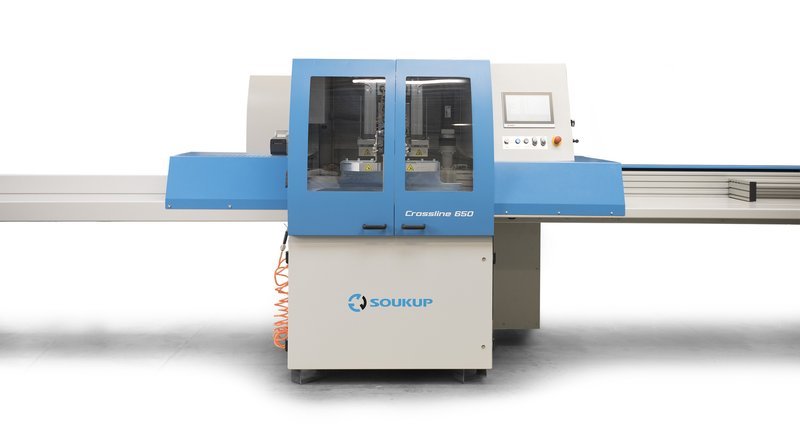
Window production demands specialized geometry that standard saws can’t provide efficiently. Double mitre saws allow for simultaneous 45-degree cuts, ensuring perfect joints for frame assembly every time. Glazing bead machines are equally vital; they provide the high-precision finishing required for modern energy-efficient glass units. The Soukup Crossline 500 stands out as a transformative piece of equipment for UK joiners. It optimizes the entire cross-cutting workflow by integrating directly with CAD software. This integration can boost production speed by 40% over traditional manual push-feed systems. If you’re looking to upgrade your current setup to meet increasing demand, you can view our full range of industrial saws to find a solution tailored to your workshop’s specific throughput requirements.
Manual vs. Automated Sawing: Calculating Your ROI
Transitioning from manual to automated processes represents the most significant leap in window production efficiency. While a traditional sawing machine requires constant operator measurement and adjustment, automated systems eliminate the human error that typically accounts for 5% to 8% of total material scrap in UK workshops. These hidden costs, which include both wasted timber and the labor time required for remakes, can easily exceed £1,200 per month for a mid-sized joinery business. Relying on an operator’s ability to read a tape measure accurately for eight hours a day is a risk that modern manufacturers can no longer afford to take.
For workshops producing between 30 and 60 windows per week, semi-automatic positioning offers a balanced middle ground. These systems use electronic stops to ensure accuracy within 0.1mm, removing the need for manual marking. When your production volume increases, the jump to a fully automated CNC sawing machine becomes necessary. These units integrate directly with CAD/CAM software, allowing cutting lists to be sent from the office to the factory floor instantly. This connectivity removes the bottleneck of manual data entry and ensures that every component is cut exactly to specification, regardless of the operator’s experience level.
Business owners often ask if their volume justifies the investment in high-end automation. Data from our UK installations suggests that if your workshop operates for more than four hours a day, the ROI on automation is typically achieved within 18 to 24 months through material savings and labor reallocation. It is not just about cutting faster; it is about cutting smarter. Even at lower volumes, the precision of a CNC system eliminates the “dry fitting” stage often required with manual cuts, saving an average of 12 minutes of assembly time per window frame.
Digital Integration and Optimization
Advanced optimization software calculates the most efficient nesting patterns before the blade even touches the wood. This process ensures that offcuts are reused or minimized based on your current inventory. By 2026, we expect remote diagnostics to be standard across all premium ranges, allowing our technicians to monitor machine health and prevent downtime before it occurs. Integrated label printers facilitate part tracking, ensuring each component is correctly identified for the next stage of CNC processing without manual handwriting errors.
Labor Efficiency and Safety
Automated material handling reduces the physical burden on your team, lowering the risk of repetitive strain injuries and fatigue-related accidents. Safety is paramount in high-output environments. Our equipment adheres to rigorous global protocols, including rapid braking systems and fully enclosed cutting zones that meet OSHA machine guarding standards for industrial saws. Implementing automated cross-cutting can reduce timber waste by up to 15% by optimizing every length of profile based on real-time stock data. This improvement directly impacts your bottom line while creating a safer, more professional environment for your staff.
Selection Criteria: Matching the Machine to Your Material
Selecting the right sawing machine isn’t just about the initial purchase price; it’s about the technical alignment with your daily throughput. If you’re processing 1,200 linear meters of timber per shift, a light-duty machine will likely fail within 18 months of intensive use. You need a robust frame and high-torque motors to maintain 0.1mm accuracy across every cut. A mismatch between your material and your machinery leads to motor strain, poor edge quality, and expensive waste.
Solid wood requires high horsepower for deep ripping, especially when dealing with 75mm oak or sapele sections. In contrast, panel products like MFC or veneered MDF demand precision scoring units to prevent breakout. A machine without a dedicated scoring motor will ruin approximately 5% of your expensive veneered boards during the sizing process, which adds up to thousands of pounds in lost margin annually.
Workshop floor space is a premium commodity in UK industrial units where rents often exceed £15 per square foot. Vertical sawing solutions can reduce your machinery footprint by up to 70% compared to traditional 3.2m sliding table saws. This allows for better workflow and reduces the time spent handling large 2440mm x 1220mm sheets, which are standard in the British joinery market. Efficient flow ensures that materials move from the rack to the saw and then to the assembly bench without creating bottlenecks that stall your entire production line.
Planning for the future is vital when making a capital investment. A machine that barely meets your current requirements will become a liability if your production volume grows by 20% next year. We recommend choosing equipment with modular upgrades or higher capacity than your current peak demand. This strategy ensures your business can scale without the disruption of replacing core machinery every few years.
Material-Specific Considerations
Hardwood ripping requires specific blade tensioning and high-torque motors to handle the density of the grain without burning the wood. For those processing MFC or Plywood, a scoring unit is non-negotiable to achieve a chip-free finish on both sides of the board. Handling heavy 100mm timbers or large-format sheets safely requires integrated support rollers and ergonomic loading systems to prevent operator fatigue and workplace injuries, which cost UK businesses millions in lost hours each year.
Technical Specifications to Scrutinize
Depth of cut is a primary metric; a machine must handle your thickest window sections with ease. Look for a throat capacity that allows for versatile cross-cutting of wide components. Fence accuracy is equally critical. You need a system that stays true even after 500 adjustments a day. Finally, consider blade change speeds. A machine that takes 15 minutes to swap a blade will cost you over 60 hours of production time annually compared to a quick-change system that takes 2 minutes.
Choosing a machine that aligns with your specific material requirements is the most effective way to guarantee long-term reliability and precision. To find the right fit for your workshop, view our range of industrial sawing machines and speak with our technical experts.
The IWM Approach: Total Sawing Solutions and UK Support
Choosing a capital investment like a high-performance sawing machine requires more than just comparing specifications on a digital datasheet. At International Woodworking Machinery Ltd, we bring 50 years of industry expertise to every consultation. This heritage represents five decades of solving production bottlenecks for UK joinery firms; it is the foundation of our technical authority. When you invest in machinery of this calibre, you aren’t just buying steel and motors. You’re securing a partnership with an industry veteran that understands the nuances of timber processing and the demands of a high-output production environment.
Seeing is believing in the world of industrial engineering. Our Newark-on-Trent showroom provides a dedicated space where you can see our machines in action under power. This facility allows business owners and workshop managers to verify build quality and precision first-hand before committing to a purchase. It’s an essential step in ensuring the hardware meets your specific tolerances and workflow requirements. We believe in transparency; testing a machine with your own material samples provides the quiet confidence needed for such a significant financial commitment.
We recognise that every workshop operates on a different financial cycle. That’s why we offer a balanced choice between cutting-edge new equipment and high-quality refurbished models. For businesses looking to scale without the full cost of new hardware, our refurbished machines often provide a 35% saving compared to latest-model equivalents. Every used unit undergoes a rigorous mechanical audit to ensure it meets our standards for durability and precision. This approach ensures that even smaller workshops can access prestige engineering without compromising on operational reliability.
Operational uptime is the heartbeat of your business. Our UK-wide technical service team is structured to provide rapid support, ensuring your production line remains active. We don’t believe in long-distance troubleshooting that leads to weeks of downtime. Instead, our engineers provide on-site expertise and preventative maintenance that protects the longevity of your investment. By focusing on long-term value rather than quick transactions, we’ve established ourselves as a trusted partner for window and door specialists across the country.
From Sawing to Waste Management
Efficiency extends beyond the initial cut. We help you close the production loop by converting timber offcuts into carbon-neutral fuel using Falach briquette presses. For those aiming for total factory automation, we specialise in integrating Soukup production lines, which are designed specifically for window and door manufacture. This holistic view of the workshop ensures every square metre of your facility is profitable. Explore our range of used industrial woodworking machines to see how we can optimise your current setup.
Expert Advice and Technical Support
Layout matters just as much as the hardware itself. A poorly positioned sawing machine can create a 15% drop in workflow efficiency due to unnecessary material handling. Our team provides tailored advice on workshop configuration to maximise throughput and safety. We also maintain an extensive inventory of spare parts in our UK warehouse, ensuring that wear-and-tear components are available for immediate dispatch. Contact our technical team for a bespoke machinery consultation to discuss your production goals.
Future-Proofing Your Production for 2026 and Beyond
Selecting the right sawing machine is a decision that dictates your workshop’s output for the next decade. We’ve highlighted how shifting toward automated solutions can deliver a clear ROI through reduced material waste and improved precision. Efficiency isn’t just about the initial cut; it’s about the reliability of your equipment under heavy industrial loads. With over 50 years of industrial woodworking expertise, IW Machines ensures your investment is backed by technical excellence and robust engineering.
As the exclusive UK partners for Soukup and Falach, we provide access to world-class manufacturing standards combined with local accountability. Our commitment to your success includes full UK-wide engineering support and a comprehensive inventory of spare parts to keep your lines running without interruption. We understand the pressure of modern production schedules and the need for machinery that performs consistently every day. Our team is ready to help you navigate these technical requirements with practical, honest advice.
Experience the precision of our range firsthand to see how we can optimise your workflow. Book a demonstration at our Newark-on-Trent showroom today. We look forward to helping you achieve a new standard of workshop excellence.
Frequently Asked Questions
What is the difference between a rip saw and a cross-cut saw?
A rip saw is designed to cut wood along the grain, while a cross-cut saw cuts across the grain. Rip saws feature fewer teeth with larger gullets to clear long fibres during the cut. In contrast, a cross-cut blade typically has 60 to 80 teeth to ensure a clean finish on the end grain. This distinction’s vital for maintaining the 0.2mm tolerances required in professional window manufacturing.
Can I use a vertical panel saw for solid wood ripping?
You can use a vertical panel saw for solid wood ripping if the machine’s equipped with a high-torque motor and appropriate tooling. Engineering leaders like Striebig produce models capable of processing solid timber up to 80mm thick with absolute squareness. It’s essential to fit a dedicated ripping blade to manage heat dissipation during long 5-metre cuts. This setup provides a versatile solution for workshops with limited floor space.
How much space is required for an industrial bandsaw setup?
An industrial bandsaw setup requires a minimum footprint of 15 square metres to accommodate the machine and the necessary material handling zones. You’ll need at least 3 metres of clear space at both the infeed and outfeed for processing standard timber lengths. Maintaining a 1.2-metre safety perimeter around the chassis ensures your workshop complies with HSE spacing standards. Proper planning prevents bottlenecks in your production flow.
What are the safety requirements for industrial sawing machines in the UK?
Industrial sawing machine safety in the UK’s strictly regulated by the Provision and Use of Work Equipment Regulations 1998, commonly known as PUWER. Every machine must feature a braking system that brings the blade to a complete stop within 10 seconds. You’re also required to conduct annual PUWER inspections. These checks ensure that all guards, emergency stops, and dust extraction systems operate at 100% efficiency to protect your workforce.
Is it better to buy a new or refurbished sawing machine?
Choosing a new machine grants you a 24-month warranty and access to the latest 4.0 industry connectivity features. While refurbished equipment can reduce your initial investment by 35%, it often lacks the energy efficiency of modern 5.5kW motors. For high-output window production, the 99% uptime of a new precision-engineered machine justifies the higher cost. It’s an investment in long-term stability rather than a short-term fix for your workshop.
How does optimization software integrate with an industrial saw?
Optimization software integrates with a modern sawing machine by transferring digital cutting lists directly to the onboard controller via a secure network. This integration typically reduces timber waste by 12% through advanced nesting algorithms. It eliminates manual data entry errors and allows for automated label printing at the outfeed. This creates a seamless data trail that follows each window component from the initial cut through to final glazing.
What maintenance is required for high-volume cross-cut saws?
High-volume cross-cut saws require a daily cleaning of the optical sensors and weekly lubrication of the carriage bearings. You should schedule a comprehensive technical audit every 1,500 hours of operation to ensure the pneumatic clamps maintain their 6-bar pressure. Replacing the circular saw blade once it loses 15% of its sharpness prevents motor strain. Consistent maintenance ensures your production line avoids the £500 hourly cost of unplanned downtime.
How do I calculate the ROI on an automated sawing machine?
To calculate the ROI, divide the total project cost by the annual savings generated from reduced labour and a 10% decrease in material waste. An automated system costing £55,000 often pays for itself within 22 months in a standard UK workshop. You should also factor in the increased throughput, as automated feeding can boost output by 40% compared to manual methods. This data-driven approach provides a clear picture of your capital’s performance.