

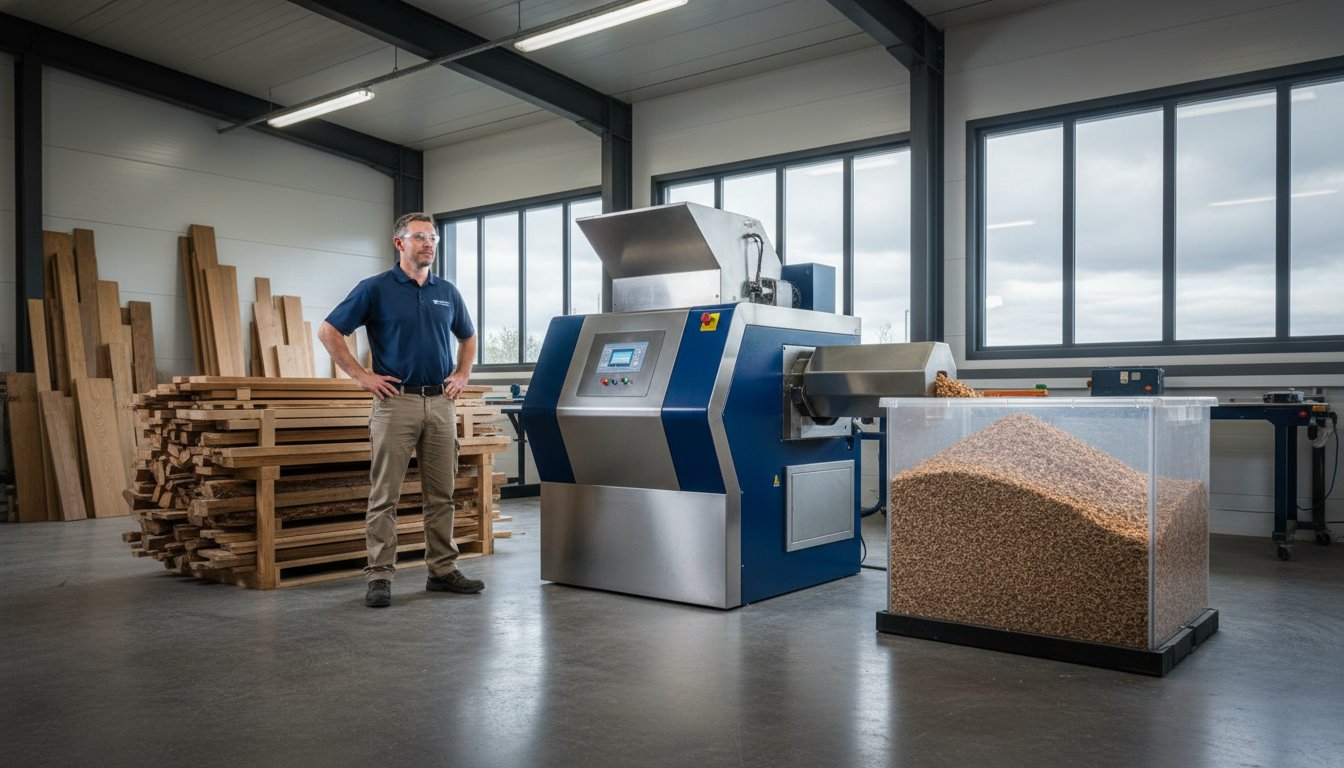
Why are you paying upwards of £450 per skip to haul away timber offcuts that could be heating your workshop for free? Most UK joinery managers recognize that rising disposal fees and the persistent fire risk of accumulated waste are unsustainable burdens on a modern production floor. When your team spends hours manually breaking down bulky offcuts, it’s a clear drain on efficiency and a potential HSE liability. Integrating a precision-engineered wooden shredder into your facility transforms this liability into a consistent, high-value resource.
We understand that capital investment requires a focus on long-term durability and measurable ROI. This guide demonstrates how industrial shredding technology reduces waste volume by up to 80%, significantly lowering your overheads while preparing material for automated briquette presses. We’ll detail the essential engineering features needed for 2026 compliance and show you how to achieve a cleaner, safer, and more profitable workshop environment through technical excellence and workflow optimization.
Key Takeaways
- Learn how to transform costly offcuts and pallet waste into valuable fuel sources, effectively turning a disposal expense into a sustainable revenue stream.
- Understand the engineering differences between a heavy-duty industrial wooden shredder and standard chippers, focusing on high-torque technology for reduced noise and maximum durability.
- Discover how to specify the correct machinery based on your weekly production volume and specific material types, from solid hardwoods to MDF and chipboard.
- Explore why shredding is the essential first step in wood-based renewable energy, providing the foundation for efficient on-site briquette production.
- Gain insights into total waste solutions and the value of live machinery demonstrations at our Newark-on-Trent showroom to ensure a long-term return on investment.
What is an Industrial Wooden Shredder and Why Does Your Shop Need One?
An industrial wooden shredder is a heavy-duty machine engineered for the continuous, high-volume processing of timber offcuts, discarded pallets, and various board wastes such as MDF or chipboard. Unlike lighter equipment, these units are built with a 100% duty cycle motor, allowing them to run throughout a full eight-hour shift without overheating. At the heart of a professional Industrial shredder lies a precision-engineered rotor equipped with reversible hardened steel cutters. These blades maintain their edge far longer than standard steel, ensuring the machine handles dense hardwoods and even the occasional stray nail found in pallet wood without catastrophic failure.
Contrast this with garden chippers or light-duty shredders. Garden units rely on high-speed impact to shatter green, wet wood, often using thin blades that dull quickly. Industrial units utilize high-torque, low-speed shearing actions. This design provides a massive increase in throughput, often reaching between 300kg and 1,500kg per hour depending on the motor configuration. For a UK workshop, this isn’t just about waste management; it’s about meeting stringent HSE standards. Reducing bulky offcuts into a controlled format significantly lowers fire risks associated with loose timber piles and ensures a cleaner, safer floor environment that complies with the latest workshop safety audits.
The Difference Between Shredding and Chipping
While the terms are often used interchangeably, the mechanical outcomes differ significantly. Chipping is generally reserved for green waste and produces irregular, thin flakes. Shredding is the preferred method for dry, processed timber because it produces a consistent material output that is ready for secondary processing. This consistency is vital if you intend to move toward automated waste recovery. Fraction size is the uniform dimension of output material required for automated systems. Without this uniformity, downstream machinery like a Falach briquette press would struggle with blockages or inconsistent density. Our range of shredders utilizes interchangeable screens to ensure the output matches your specific requirements exactly.
Key Benefits for UK Manufacturing in 2026
The economic landscape for UK manufacturers in 2026 demands extreme efficiency. Waste disposal costs continue to rise, with standard skip hire for wood waste often exceeding £400 per lift in many industrial hubs. By implementing a wooden shredder, businesses can achieve a volume reduction of up to 80%. This translates to a 60% reduction in skip collection frequency, providing a direct boost to the bottom line within the first year of operation.
Beyond the financial savings, space optimisation is a primary driver for investment. A typical workshop might lose 15 to 20 square metres of floor space to overflowing waste bins and pallet stacks. Shredding this material on-site reclaims that valuable real estate for production machinery or assembly areas. Finally, shredding acts as the essential first step in resource recovery. By preparing your waste material into a consistent fraction, you transform a disposal liability into a valuable fuel source for biomass boilers or raw material for high-quality briquette production. This creates a circular economy within your own facility, reducing your reliance on external energy and waste contractors.
Types of Wood Shredding Technology for Manufacturing
Selecting the right wooden shredder requires a clear understanding of how material characteristics dictate machine performance. Most industrial woodworking facilities rely on two primary categories of technology: single-shaft and horizontal shredders. Both systems typically utilise a slow-speed, high-torque drive mechanism. This engineering choice is deliberate. By rotating at lower RPMs, these machines generate significantly less noise, often keeping decibel levels below 80dB, which is vital for compliance with UK workplace noise regulations. This slower rotation also reduces heat buildup, extending the service life of cutting tools by up to 35% compared to high-speed tub grinders.
A critical component in maintaining consistent throughput is the hydraulic pusher. This system monitors the load on the main motor and automatically advances the waste material against the rotating shaft. If the motor senses a spike in resistance, the pusher retracts briefly to prevent a jam. This automated cycle ensures the machine operates at peak efficiency without constant operator intervention. Processing timber waste into a uniform fraction is the first step toward creating sustainable bioenergy, a process that turns a disposal cost into a carbon-neutral heating resource.
Single-Shaft Shredders: The Industry Standard
Single-shaft units are the workhorses of the modern joinery shop. These machines feature a large hopper where mixed waste, including solid timber blocks, chipboard, and MDF, is deposited. The mechanism involves a rotating shaft fitted with four-way rotatable cutters that shear against a fixed counter-knife. This design allows for high versatility; a single 15kW unit can often process between 300kg and 600kg of material per hour. The final chip size is controlled by interchangeable screens located beneath the rotor. For businesses preparing material for a Falach briquette press, a 15mm or 20mm screen is usually recommended to ensure the resulting chips flow easily into the press hopper.
Horizontal Shredders for Long Offcuts
Horizontal shredders serve a specific niche, primarily handling long timber strips and edge-trimming waste that would bridge or “nest” in a standard vertical hopper. These units are often positioned directly behind a multi-rip saw or a 4-sided planer. Material is fed via a vibrating conveyor or a set of aggressive feed rollers that pull the timber into the cutting head. This method is 25% more efficient for long-form waste because it eliminates the need for manual pre-cutting. If your production line generates consistent 3-metre offcuts, a horizontal unit prevents the downtime associated with clearing hopper blockages in vertical machines.
Safety and legal compliance remain paramount when integrating new machinery into a British workshop. Every wooden shredder supplied must carry the UKCA or CE mark, ensuring it meets rigorous safety standards regarding emergency stops, interlocked guards, and dust extraction ports. We find that 95% of our clients prioritise these safety features to ensure long-term operational security. Our specialists can help you determine which feed system aligns with your current floor plan; you can explore our integrated shredding solutions to find the right match for your volume requirements.
The choice between these technologies ultimately depends on your waste profile. While single-shaft machines offer the broadest flexibility for general joinery, horizontal units provide unmatched efficiency for high-volume linear waste. Both systems provide the essential feedstock required for a briquetting operation, reducing waste volume by up to 80% and providing a reliable source of fuel for biomass boilers.
The Economics of Wood Waste: From Shredding to Briquetting
Many workshops treat timber offcuts as a liability. They pay for skips. They pay for manual labor to move waste across the factory floor. This is a linear loss that drains your bottom line. By integrating a wooden shredder, you transform this workflow into a circular economy. Shredding serves as the enabling technology for renewable energy, preparing raw offcuts for a Falach press by turning bulky timber into uniform feedstock. It moves your business from a disposal model to a recovery model, turning a monthly invoice into a valuable fuel source.
Proper waste handling is about more than just clearing floor space. Following the core principles found in the EPA’s Guide for Industrial Waste Management helps businesses standardise their handling of non-hazardous materials. For a UK joinery, this means moving away from the “waste” mindset entirely. When you shred your offcuts, you’re creating a commodity. This shredded material is the perfect feedstock for Falach briquette presses, which require a consistent particle size to produce high-density logs that burn efficiently in biomass boilers.
Preparing Feedstock for Briquette Production
Success in briquetting depends on two variables: moisture and particle size. Most joinery waste is ideal because it’s already kiln-dried to under 15% moisture. Investing in a high-performance wooden shredder ensures that even the most awkward offcuts are reduced to a consistent 10mm to 15mm chip. This is the sweet spot for compression. If the chips are too large, the briquette lacks structural integrity. If they’re the right size, the Falach hydraulic ram creates a dense, dust-free log. We offer the full Falach range through IW Machines, providing solutions for small workshops and high-volume industrial units alike.
Calculating Your Potential Savings
The financial argument for a combined shredding and briquetting line is compelling. You need to look at three specific areas of savings to see the full picture:
- Skip Hire Costs: A 40-yard skip in the UK typically costs between £400 and £550 per lift. A business filling one skip per month spends over £5,000 annually just on disposal.
- Heating Expenses: Replacing commercial gas or electric heating with a biomass system fed by your own briquettes can reduce energy bills by up to 80%.
- Labour Efficiency: Automating waste processing reduces the time staff spend handling offcuts. It’s a significant workflow optimization that keeps your team focused on production.
For a medium-sized joinery shop, the ROI for a shredder and press combination typically lands between 18 and 36 months. This timeline has shortened recently as energy prices remain volatile and landfill taxes continue to rise. You aren’t just buying a machine; you’re securing your energy independence. For more details on choosing the right model, see our Guide to Wood Waste Briquette Machines. The synergy between a shredder and a Falach press creates a self-sustaining loop that protects your margins and improves your environmental credentials simultaneously.
How to Specify the Right Shredder for Your Production Volume
Selecting the correct machinery begins with a precise audit of your weekly waste output. A joinery shop generating 5 tonnes of offcuts per week requires a significantly different specification than a high-volume factory producing 25 tonnes. You must measure your waste by volume, typically in cubic metres, to determine the necessary hopper capacity and throughput speed. For most UK SMEs, a throughput of 100kg to 300kg per hour provides the necessary headroom to manage peak production periods without creating bottlenecks. Over-specifying leads to unnecessary energy costs, while under-specifying results in mechanical strain and frequent downtime.
The technical requirements of a wooden shredder are largely dictated by your workshop’s electrical infrastructure. Most industrial units require a 400V 3-phase supply. An 11kW motor is often sufficient for general joinery waste, but moving to an 18.5kW or 22kW motor becomes necessary when processing dense materials or high volumes of scrap. You must verify that your local transformer and distribution board can handle the start-up current of these larger motors. In smaller workshops where floor space is limited to less than 200 square metres, the footprint of the machine is a decisive factor. Modern compact shredders occupy roughly 2 to 4 square metres, allowing them to sit adjacent to the briquette press for a streamlined workflow.
Noise pollution is a regulatory and operational concern. High-performance shredders now operate between 78dB and 82dB, which is significantly quieter than older generation granulators. This reduction in decibels is achieved through slower rotor speeds and precision-engineered cutting blocks. Choosing a machine with these specifications ensures you remain compliant with UK workplace noise regulations while maintaining a productive environment for your staff.
Material-Specific Considerations
MDF and chipboard present unique challenges due to the high concentration of urea-formaldehyde resins and glues. These synthetic binders are highly abrasive and can dull standard steel blades 35% faster than natural timber. We recommend carbide-tipped or hardened steel cutters for these materials to maintain edge retention. Hardwood offcuts from species like Oak or Sapele demand higher torque levels. A high-torque, low-speed drive system prevents the rotor from stalling when encountering dense knots or thick sections. If you process pallets, your wooden shredder must include a magnetic overband separator. This component removes the 40 to 60 steel nails typically found in a standard UK pallet, protecting your briquette press from catastrophic internal damage.
The careful handling of valuable hardwoods like Oak highlights the material’s enduring appeal. While modern workshops focus on efficiently processing offcuts, the heritage of English woodworking provides a fascinating contrast, showcasing timber transformed into lasting works of art. For those interested in the pinnacle of this craft, you can discover Nicholas Wells Antiques and explore centuries of design.
Integration with Extraction Systems
Efficient waste management relies on how the shredded material moves from the cutters to the briquette press. You can choose between a mechanical discharge conveyor or a pneumatic extraction hood connected to your existing LEV (Local Exhaust Ventilation) system. Most industrial shredders feature 160mm or 200mm extraction ports to match standard UK ducting sizes. Closed-loop extraction systems represent the gold standard for workshop air quality by ensuring that fine particulates are contained within a sealed circuit rather than being released into the production environment. This setup reduces the load on your primary dust unit and keeps the floor clear of combustible debris.
To ensure your machinery investment delivers long-term reliability and engineering excellence, view our full range of industrial shredders and briquette presses today.
Industrial Wood Waste Solutions from IWM
International Woodworking Machinery Ltd (IWM) stands as the UK’s primary authority on industrial wood waste management, bringing over 50 years of engineering expertise directly to your factory floor. Since our inception in 1974, we’ve focused on helping British manufacturers transform bulky offcuts and shavings into revenue-generating assets. We don’t just supply machinery; we provide the technical framework required to optimize your entire production environment. Our 15,000-square-foot showroom in Newark-on-Trent serves as a central hub where clients see Falach technology operating under real-world conditions. Seeing a machine run in person is vastly different from reviewing a specification sheet. It allows your team to hear the motor under load, observe the consistency of the briquette output, and understand the physical footprint required for installation.
Our “Total Solution” approach ensures that every stage of your waste cycle is synchronized for maximum efficiency. This strategy often begins with the initial volume reduction via a high-torque wooden shredder, followed by efficient extraction systems that feed directly into a Falach briquette press. By integrating these components into a single, cohesive workflow, we eliminate the bottlenecks that occur when waste is handled manually. This level of automation reduces labor costs and keeps your workspace clear of fire hazards. We’ve found that businesses integrating a robust wooden shredder into their line can reduce waste volume by up to 80% before it even reaches the compaction stage, significantly increasing the throughput of the entire system.
Long-term reliability is the cornerstone of our service model. We support every installation with a dedicated network of UK-wide service engineers who understand the nuances of industrial woodworking. Whether you’re based in Scotland or the South West, our team provides rapid response times to ensure your investment continues to perform at 100% capacity. We maintain a comprehensive inventory of genuine spare parts at our UK warehouse, boasting a 95% first-time fix rate for common maintenance requirements. This commitment to after-sales support reflects our position as a trusted partner rather than a simple equipment vendor. We recognize that for a B2B buyer, a machine is only as valuable as the support system standing behind it.
Why Choose IWM for Your Shredding Equipment?
Our technical advice is always tailored to your specific production workflow rather than a generic product sale. We analyze your material density, moisture content, and daily waste volume to recommend a configuration that delivers the best return on investment. The reliability of our prestige brands stems from precision-engineered components designed for multi-shift operation. You gain peace of mind through our structured maintenance schedules, which are designed to protect your warranty and extend the machine’s operational lifespan. We focus on engineering excellence to ensure your equipment remains a stable asset for decades.
Next Steps: Consultation and Showroom Visits
We encourage all prospective clients to bring their own waste material to our Newark showroom for a trial session. This 90-minute demonstration proves exactly how the machinery handles your specific timber species or board types. Following a successful trial, our engineers conduct detailed site surveys to plan the machine’s placement, electrical requirements, and extraction ducting. This methodical approach ensures there are no surprises during the installation phase. Contact our technical team for a bespoke waste audit to see how much your business could save by converting scrap into fuel.
Future-Proofing Your Wood Waste Management for 2026
Investing in a high-performance wooden shredder transforms bulky offcuts into a manageable resource, significantly reducing disposal costs that often exceed £120 per tonne in current UK landfill taxes. By integrating shredding technology with briquetting, your workshop can achieve a circular economy, potentially cutting annual heating bills by 30% or more. IW Machines brings 50+ years of industry expertise to your production floor, ensuring you select a robust system tailored to your specific volume requirements. We invite you to visit our dedicated showroom in Newark-on-Trent to see these precision-engineered machines in action. Every installation is backed by our full UK-wide engineering support, providing the technical integrity and peace of mind your business requires for long-term growth. It’s time to turn your waste stream into a profit centre with reliable, professional-grade technology.
View our range of industrial wood waste machinery
Frequently Asked Questions
Can an industrial wooden shredder handle nails and screws?
Modern industrial wooden shredders process timber containing small metal fasteners like nails and screws without sustaining structural damage. These machines use robust, slow-speed rotors and hardened steel cutters that withstand occasional 4mm screws or 50mm nails. While the machine handles these materials, removing 100% of metal contaminants can extend your tool life by 30% and reduces the risk of sparks in your extraction system.
What is the difference between a wood chipper and a wood shredder for a workshop?
The primary difference lies in the output consistency and the mechanism; a chipper uses high-speed knives to create large flakes, while a shredder uses a slow-speed rotor to grind material into uniform fractions. While a chipper might process 5 cubic metres of green waste per hour, a workshop shredder focuses on dry joinery waste. This controlled output is essential for Falach briquette presses, which require a consistent 10mm to 15mm particle size for optimal compression.
How much space does an industrial wood shredder require?
A standard industrial wood shredder typically requires a footprint of 4 to 6 square metres, which includes the necessary clearance for maintenance and material feeding. You should allow at least 1.5 metres of open space around the hopper for safe operation and forklift access. If you integrate the unit with a Falach briquette press, the total installation might occupy 12 square metres of floor space to ensure a smooth workflow and compliance with UK health and safety regulations.
Do I need a specific type of extraction for a wood shredder?
You must use a dedicated dust extraction system that meets HSE COSHH standards to manage the fine particles generated during the shredding process. We recommend a system with a minimum airflow of 25 metres per second to prevent blockages in the ducting. If you’re processing MDF or chipboard, the extraction unit must include HEPA filtration to capture 99.97% of hazardous dust, ensuring your workshop environment remains safe during an 8-hour shift.
What size of wood chips are produced by an industrial shredder?
Most industrial shredders produce chips ranging from 10mm to 30mm in diameter, depending on the screen size installed in the machine. For briquette production, we typically install a 15mm screen to ensure the raw material flows correctly into the press hopper. Changing the screen takes approximately 20 minutes and allows you to tailor the output for specific heating systems or animal bedding requirements.
Can I shred MDF and chipboard for briquette making?
You can shred MDF and chipboard for briquette making, provided your wooden shredder is equipped with hard-wearing cutters to handle the abrasive resins. These engineered timbers contain high levels of glue, which can increase blade wear by 25% compared to solid softwoods. When pressing these materials, the Falach press effectively manages the higher density, but you must ensure your extraction system is rated for the specific fine dust produced by these boards.
How often do the blades on a wood shredder need to be sharpened or replaced?
Shredder blades typically require rotation or replacement every 300 to 500 operating hours, depending on the contamination levels of your waste stream. Most modern rotors feature four-sided indexable inserts; you simply rotate the blade 90 degrees to expose a fresh cutting edge. This design reduces downtime to less than 60 minutes for a full set change, maintaining a sharp profile that reduces energy consumption by 15% during the grinding process.
Is an industrial shredder loud enough to require additional hearing protection?
Industrial shredders often generate noise levels between 80dB and 95dB, which exceeds the HSE lower exposure action value of 80dB. Operators must wear ear protection that provides a minimum attenuation of 20dB to ensure safety during prolonged use. While a slow-speed wooden shredder is significantly quieter than a high-speed chipper, the impact of timber against the hopper creates noise peaks that necessitate a strict hearing conservation programme for your workshop staff.