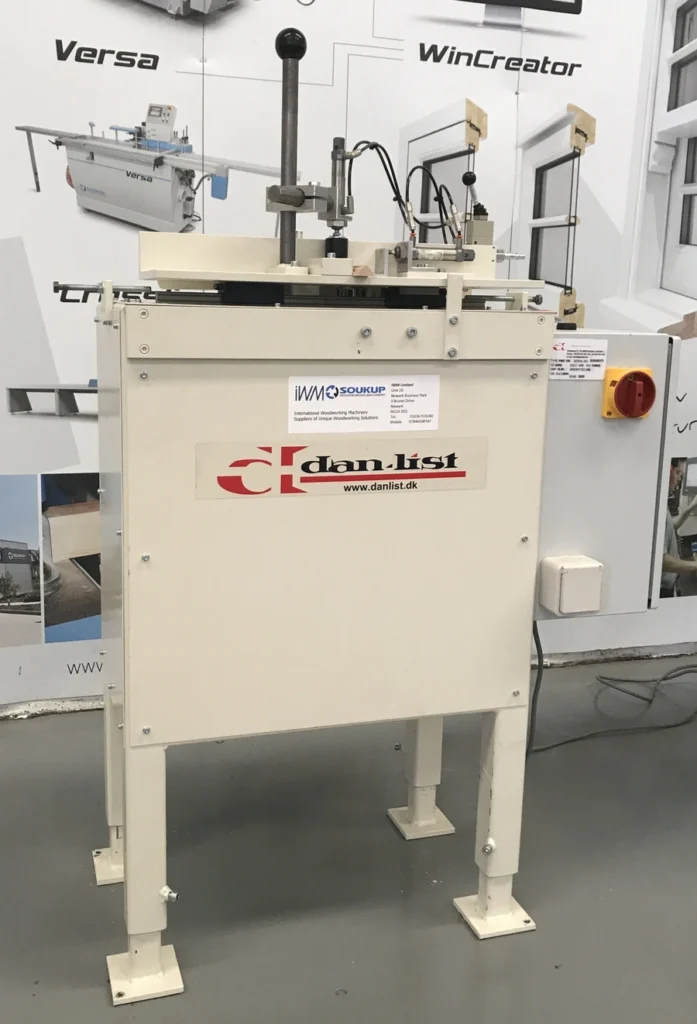
A purpose-built machine for scribing the ends of cross-cut glazing bead and profiled timber — producing a clean, tear-free counter-profile in a single manual pass. The right choice for joinery shops that need consistent, repeatable bead ends without rework.
Typically chosen by
Joinery shops producing window frames or door units that require accurately scribed glazing bead ends as part of finished assemblies
Workshops where tear-out on cross-cut profiled timber is causing rework or quality rejections
Operations looking to bring bead end-profiling in-house rather than relying on manual routing or outsourcing
Bring us a sample profile or board and we'll run it through the machine at our Newark showroom. You'll see the output quality firsthand and we can talk through how it fits your workflow - before any decisions are made.
The workpiece moves laterally across twin router bits rather than the head traversing — this approach gives more controlled feed and contributes to the tear-free cut quality.
Cutter Configuration
Two counter-rotating router bits at 18,000 rpm
The twin-cutter setup — one clockwise, one anticlockwise — profiles both sides of the bead end in a single pass, eliminating breakout on the exit edge.
Max Routing Height / Width
Approx. 90 mm × 90 mm (profile/tooling dependent)
Actual usable capacity will vary with profile geometry and tooling selection — confirm with IWM when specifying tooling.
Optional 90° Cut-Off Saw
Available as factory option
Combining cross-cutting and end-profiling in one machine can reduce handling time if bead is being cut to length and profiled as part of the same operation.
Pneumatic clamping holds the workpiece securely and consistently throughout the cut cycle, removing reliance on operator hand pressure and reducing the risk of movement-induced breakout.
Optional 90° Cut-Off Saw
Available as factory option
Motor Power
1.5 kW
Three-phase 400 V supply required — confirm your workshop supply is adequate before ordering.
Electrical Supply
400 V, 3-phase
Machine Dimensions (L × W × H)
Contact IWM for confirmed figures
Allow additional clearance on the left and right of the machine for the full lateral travel of the sliding table and operator access.
Machine Weight
Contact IWM for confirmed figures
Extraction Requirement
Contact IWM for confirmed figures
Dust extraction connection is required — confirm port size and volume flow with IWM when planning installation.
Choose the Dan-List PME 100 Endscribe Machine if...
Your main requirement is clean, tear-free end profiles on glazing bead and you want a machine purpose-built for that single task
You process a consistent volume of cross-cut profiled bead and want a reliable, repeatable result without manual intervention
You want the option to cross-cut and end-profile in one place by adding the 90° saw at the time of order
Consider an alternate model if...
You need to profile bead ends as part of a broader range of scribing and profiling operations — the Copenstick TDL or Copenstick UNI may offer more versatility across profile types
You need pin-and-cope or stick-and-cope joinery profiling rather than end scribing — in which case the Copenstick PIN or Copenstick STP are more appropriate starting points