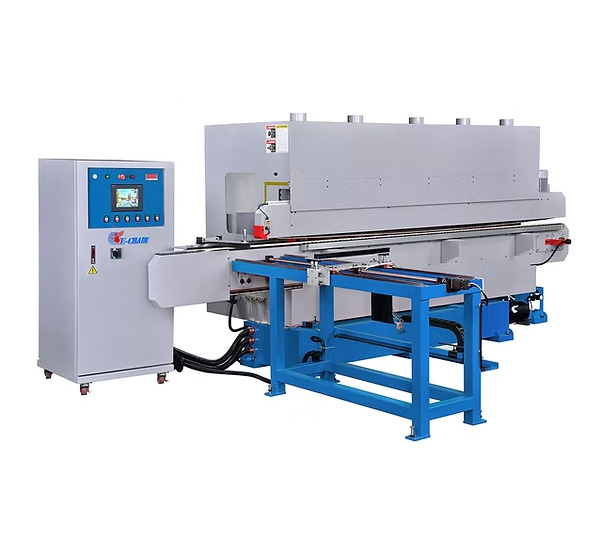
ECT-SET100

E-Chain
Process both ends of a panel or frame component in one pass — with independent moulding units, variable feed, and optional profile sanding built in. For joinery and window manufacturers who need consistent output across a full shift.

Typically chosen by

  • Joinery shops running regular batches of tenoned frames or door components who need consistent results across a shift
  • Window and frame manufacturers processing panels of varying thickness up to 100mm who want a single machine to handle the full range
  • Workshops looking to move away from single-end processing and reduce double-handling on tenoning operations

Key specification considerations

Max. Working Thickness
100 mm
Feed Speed
5–25 m/min (variable)
The wide range lets you slow down for dense hardwoods or heavily profiled sections and speed up for softwood or simpler runs — without changing the setup.
Moulding Unit Motors
Unit 1: 7.5 hp (10 hp opt.) · Unit 2: 10 hp
Machine Weight
4,250 kg (net)
At this weight, floor loading must be checked before installation — a structural engineer or your building contractor should confirm the slab specification.
SpecificationValueNotes
Max. Working Thickness
100 mm
Working Length
100 mm and over
Feed System
Chain track
Feed Drive Motor
3 hp (5 hp optional)
Feed Speed
5–25 m/min
Variable feed means you can match speed to material and profile without changing tooling or setup.
Distance Between Dogs
400 mm (300 / 200 mm optional, or without dogs)
Dog spacing determines the minimum repeat length in a batch run — confirm your typical panel lengths before specifying this option.
Moulding Unit 1 — Motor
7.5 hp (10 hp optional)
Moulding Unit 1 — Spindle Speed
4,500–8,000 rpm (10,000 rpm optional)
Moulding Unit 1 — Jumping Function
Yes (standard)
The jumping function allows the spindle to lift clear of the workpiece at the start and end of a pass, reducing breakout on the leading and trailing edges.
Moulding Unit 1 — Spindle Diameter
40 mm
Moulding Unit 1 — Cutter Diameter
190–250 mm
Moulding Unit 2 — Motor
10 hp
Moulding Unit 2 — Spindle Speed
4,500–6,000 rpm (10,000 rpm optional)
Moulding Unit 2 — Spindle Diameter
40 mm
Moulding Unit 2 — Cutter Diameter
190–250 mm
Profile Sanding Unit — Motors
3 hp × 3 units
Profile Sanding Unit — Spindle Speed
0–1,800 rpm
Optional HSK Spindle System
Available
HSK tooling allows faster cutter changes between jobs — worth specifying if you run frequent profile changeovers.
Net Weight
4,250 kg
Floor loading must be verified before installation at this weight.
Gross Weight (packed)
4,600 kg
Machine Dimensions (L×W×H)
4,110 × 1,620 × 1,900 mm
Allow additional clearance at both in-feed and out-feed ends for your longest workpieces, plus extraction ducting on both moulding units.
Packing Dimensions (L×W×H)
4,230 × 1,600 × 2,120 mm
Electrical Supply
Please enquire
Phase and amperage requirements should be confirmed with us before ordering — your electrical supply must be verified against the machine's demand.
Noise Level
Please enquire
Noise output varies with tooling configuration and feed speed — ask us for measured data relevant to your intended setup, and consider acoustic treatment if your workshop has noise exposure limits to manage.

Is this the right
machine for you?

Choose the ECT-SET100 if...

  • You are tenoning both ends of a panel in a single pass and want to eliminate the re-handling that comes with single-end processing
  • Your production runs panels or frames with profiles on each end and you need two independent moulding units to handle them in one operation
  • You process a range of section thicknesses up to 100mm and need variable feed speed to accommodate different materials in the same shift
  • You want the option of profile sanding integrated into the same machine pass, reducing the number of separate operations

Consider an alternate model if...

  • You only need to tenon one end at a time or run lower volumes — the ECT-C2 Single End Grooving Machine may be a more proportionate fit for your output
  • Your work is primarily flooring profile rather than frame or panel tenoning — the dedicated Tenoners For Flooring range is configured specifically for that application
  • You need CNC-controlled axis positioning and automatic size setting between jobs — the NC Type Automatic Double End Tenoner would be more appropriate
  • Your panels require sizing as well as tenoning in the same pass — the Double End Sizer C Type is worth discussing with us instead
Still not sure? We're happy to help
Ready when you are

Ready to improve your
workshop's output?

Book a specification call with one of our engineers. Thirty minutes, no obligation, plain English advice on what would actually work on your floor.