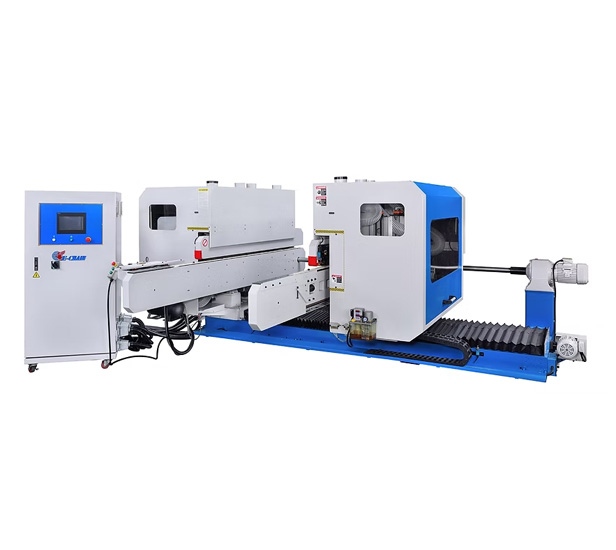
Control System | NC Servo | NC servo positioning allows axis adjustments to be made automatically and stored as named recipes, removing the need for manual re-setting between jobs. |
Tooling Interface | HSK 63F | HSK tooling offers faster, more repeatable tool changes than conventional arbor-mounted tooling, which matters when you are switching profiles regularly. |
Work Holding | Automatic Dogs | Automatic dogs clamp and feed workpieces without manual intervention, keeping throughput consistent and reducing the operator handling required per piece. |
Recipe Storage | Yes | Stored job recipes let operators recall a previous setup in seconds rather than re-measuring and re-setting from scratch each time a repeat job comes in. |
Working Width (min–max) | Configured to order — confirm with IWM | Working width range is set at the time of specification; talk to us about your widest and narrowest workpieces before ordering. |
Working Height (min–max) | Configured to order — confirm with IWM | Working height capacity depends on the hold-down and pressure beam specification chosen; confirm your maximum workpiece thickness when enquiring. |
Feed Speed | Configured to order — confirm with IWM | Feed speed is set to match your production volume and material; faster feed rates require verified extraction capacity at the infeed and outfeed. |
Spindle Speed | Configured to order — confirm with IWM | |
Number of Spindles | Configured to order — confirm with IWM | Spindle count is determined by the number of working units specified; discuss your profile complexity with us to arrive at the right configuration. |
Motor Power (total) | Configured to order — confirm with IWM | Total connected load varies with the number and type of working units fitted; confirm three-phase supply capacity and available amperage with your electrician before ordering. |
Electrical Supply | Three-phase — confirm voltage and frequency with IWM | Three-phase supply is required; confirm your site voltage (typically 400 V / 50 Hz in the UK) when enquiring so we can specify the correct panel configuration. |
Machine Dimensions (L × W × H) | Configured to order — confirm with IWM | Overall footprint depends on frame length and number of working units; allow additional clearance at both infeed and outfeed ends for workpiece handling and operator access. |
Machine Weight | Configured to order — confirm with IWM | Heavy-duty welded steel construction means floor loading should be checked with a structural engineer before installation, particularly on upper floors or older industrial premises. |
Extraction Connection | Configured to order — confirm with IWM | Extraction connection sizes depend on the working units fitted; confirm your existing ductwork diameter when specifying so extraction can be sized correctly. |
Noise Level | Confirm with IWM at point of specification | Noise output varies with spindle count, feed speed, and material; acoustic treatment or hearing protection requirements should be assessed once the machine configuration is finalised. |
CE Marked | Confirm with IWM | CE marking confirms the machine meets applicable EU Machinery Directive requirements; for UK supply, confirm UKCA compliance with us at the time of enquiry. |