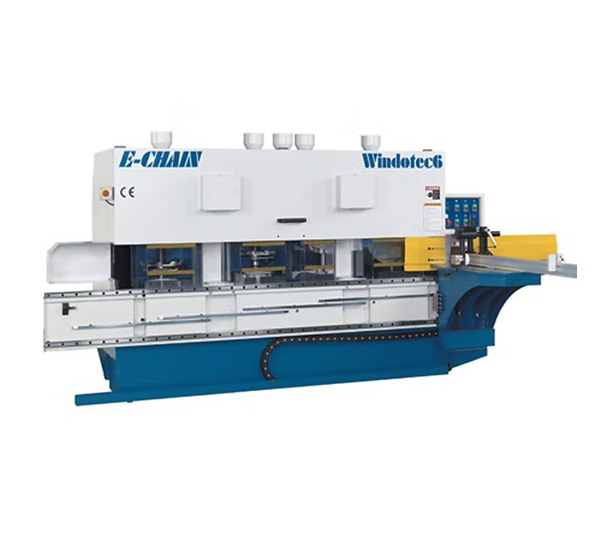
Working Table Size | 800 x 400 mm (all variants) | |
Fence Length | 2400 mm (all variants) | Supports longer components such as full-height window stiles without the workpiece overhanging unsupported. |
Compressed Air Connections | 2 pcs (all variants) | An on-site compressed air supply will be required — confirm pressure and flow rate with IWM before installation. |
Main Saw — Motor Power | 5 hp (all variants) | |
Main Saw — Spindle Speed | 3000 rpm at 50 Hz (all variants) | |
Main Saw — Spindle Diameter | 30 mm (all variants) | |
Main Saw — Blade Diameter | 450 mm (all variants) | |
Main Saw — Max. Cutting Height | 150 mm (all variants) | |
Top & Bottom Horizontal Spindles — Motor Power | Not fitted (3-spindle) / 3 hp x 2 pcs (5-spindle) / 3 hp x 2 pcs (6-spindle) | These scribing spindles are what allow the 5 and 6-spindle variants to undercut the shoulder cleanly — essential for a tight-fitting tenon on profiled sections. |
Top & Bottom Horizontal Spindles — Spindle Speed | Not fitted (3-spindle) / 3000 rpm at 50 Hz (5 & 6-spindle) | |
Top & Bottom Horizontal Spindles — Spindle Diameter | Not fitted (3-spindle) / 40 mm (5 & 6-spindle) | |
Top & Bottom Horizontal Spindles — Spindle Length | Not fitted (3-spindle) / 150 mm (5 & 6-spindle) | |
Top & Bottom Horizontal Spindles — Blade Diameter | Not fitted (3-spindle) / 160 mm (5 & 6-spindle) | |
Vertical Spindle 1 — Motor Power | 10 hp (all variants) | |
Vertical Spindle 1 — Spindle Speed | 3000 rpm at 50 Hz (all variants) | |
Vertical Spindle 1 — Spindle Diameter | 40 mm (all variants) | |
Vertical Spindle 1 — Spindle Length | 180 mm (all variants) | |
Vertical Spindle 1 — Cutter Diameter | 350 mm (all variants) | |
Vertical Spindle 2 — Motor Power | Not fitted (3 & 5-spindle) / 10 hp (6-spindle) | The second vertical spindle on the 6-spindle variant allows an additional profile or cope operation in the same pass — relevant where your section requires more than one vertical cut. |
Vertical Spindle 2 — Spindle Speed | Not fitted (3 & 5-spindle) / 3000 rpm at 50 Hz (6-spindle) | |
Vertical Spindle 2 — Spindle Diameter | Not fitted (3 & 5-spindle) / 40 mm (6-spindle) | |
Vertical Spindle 2 — Spindle Length | Not fitted (3 & 5-spindle) / 180 mm (6-spindle) | |
Vertical Spindle 2 — Cutter Diameter | Not fitted (3 & 5-spindle) / 350 mm (6-spindle) | |
Machine Dimensions (L x W x H) | 2080 x 2700 x 1900 mm (3-spindle) / 2740 x 2700 x 1900 mm (5-spindle) / 3190 x 2700 x 1900 mm (6-spindle) | Allow additional clearance beyond the machine footprint for workpiece infeed and outfeed, operator access, and extraction ducting — the 6-spindle variant in particular will require careful shop floor planning. |
Net Weight | 1850 kg (3-spindle) / 2200 kg (5-spindle) / 2450 kg (6-spindle) | |
Gross Weight (packed) | 2000 kg (3-spindle) / 2350 kg (5-spindle) / 2600 kg (6-spindle) | |
Packing Dimensions (L x W x H) | 2290 x 2000 x 2100 mm (3-spindle) / 2850 x 2000 x 2100 mm (5-spindle) / 3300 x 2000 x 2100 mm (6-spindle) | |
Electrical Supply | Confirm with IWM at point of enquiry | Phase and amperage requirements vary by configuration and must be established before ordering to ensure your workshop supply is adequate — speak to IWM for the figure relevant to your chosen variant. |
Noise Level | Confirm with IWM at point of enquiry | Operating noise levels for multi-spindle tenoners of this type typically exceed 80 dB — acoustic treatment or hearing protection measures should be assessed for your workshop before installation. |
Feed Speed | Confirm with IWM at point of enquiry | Feed speed directly affects output rate and finish quality — discuss your target cycle time with IWM to confirm the available range suits your production requirements. |
Min. / Max. Workpiece Length | Confirm with IWM at point of enquiry | Minimum workpiece length determines whether your shortest components — such as short door rails — can be processed safely; confirm this against your section schedule before specifying. |