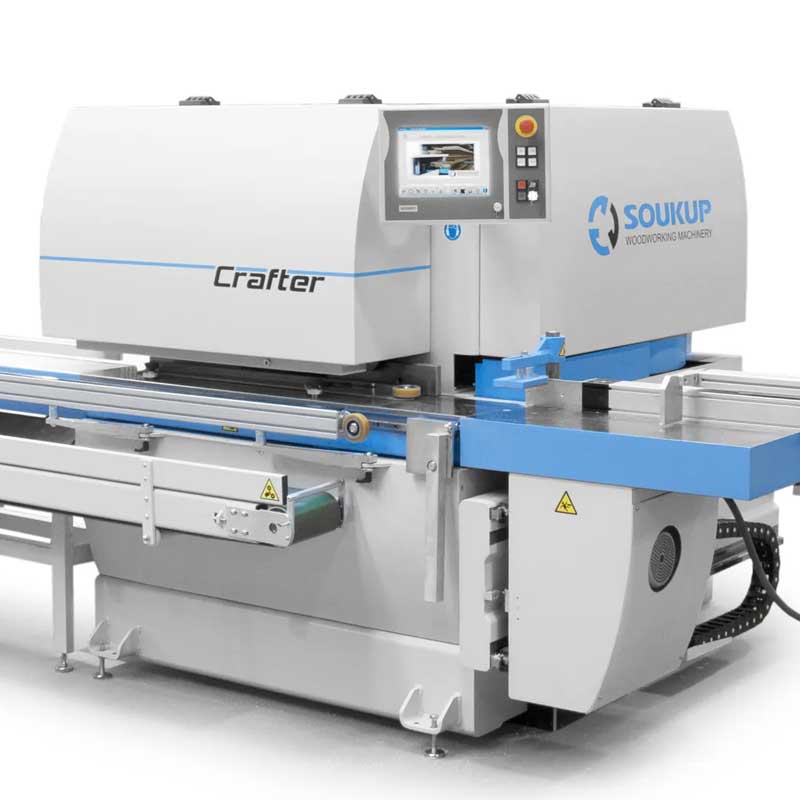
Manufacturer | Soukup | |
Machine Type | CNC Window Machining Centre | |
Material | Timber only | |
Casement — Frame Operations | Tenoning and profiling of frames; tenoning and profiling of casements with shortened rail tenon for stormproofing; full machining of components without stormproofing (flush, stormproof, high performance) | |
Casement — Glazing Operations | Recovery of glazing beads and sticking bars from frame rebate | |
Sliding Sash — Sash Box Operations | Open tenons and slots; horn milling in different moulds; meeting rail slot adaptation to parting bead; traditional bevelled meeting rail profiling; outside profiling and grooving for cord, gasket, or balance springs | Mortising of sash stiles is carried out off-line — confirm off-line mortising provision before specifying this machine. |
Sliding Sash — Box Frame Operations | Tenoning and profiling of box parts for balance springs; cill notching for interior lining bead; divided cill profiling; slot trenching in cill and head for pulley stiles; cutting of moulded pulley stiles, lining beads, and cill extension | Pulley stiles, lining beads, head and cill extensions are moulded off-line — these operations can be carried out on the Soukup Versa Max; confirm your off-line moulding provision is in place before specifying. |
Anti-Splitting System | Double-cycle tenoning; cross wood milled out during tenoning cycle — no corner spindle jump required | This approach leaves only longitudinal wood for outside milling, reducing tear-off risk and improving consistency on small sashes where stability is typically the limiting factor. |
Tooling Configuration | Electronically controlled cut-off saw; CNC tenoning spindle; CNC profiling spindle; horizontal milling unit (horn milling and cill trenching) | Tool stacks on the tenoning and profiling spindles adjust automatically to the programmed height and depth — discuss specific profile and tooling requirements with IWM before ordering. |
CNC Control System | Beckhoff industrial PC with 12" touch screen panel; Soukup WinCreator software supplied as standard | The system is also compatible with Klaes and Joinerysoft, so workshops already using either package can integrate without switching software. |
Min/Max Component Length | 220 mm min / 2,900 mm max (measured between tenons) | The 220 mm minimum is the practical limit for smaller sashes — workshops regularly producing cottage or heritage glazing bars should confirm their shortest components against this figure. |
Daily Output (1 operator) | 8–12 complete sliding sash windows; 15–20 casements; 30–40 single sashes | Output figures assume a competent single operator on a standard shift; profile complexity and timber preparation will affect actual throughput. |
Dimensions (Floorspace) | 2,000 mm × 2,000 mm | Allow additional clearance beyond the machine footprint on all feed sides and for extraction ducting — confirm usable floor area with IWM before ordering. |
Weight | 3,000 kg | At 3,000 kg, floor loading should be assessed before installation, particularly in older workshop buildings or on suspended floors. |
Power Requirement | 3-phase, 415 V, 50 Hz | Confirm that a suitable three-phase 415 V supply with adequate amperage capacity is available at your site before ordering. |
Noise Level | 90 dB(A) | 90 dB(A) is above the HSE upper exposure action value of 85 dB(A) — acoustic treatment and mandatory hearing protection for operators will be required under the Control of Noise at Work Regulations 2005. |